

The Ultimate Off-Grid Problem
On Earth, Global Navigation Satellite Systems (GNSS) like GPS are woven into the fabric of daily life. They work because a constellation of satellites blankets the planet with steady signals. On the Moon, however, this system is not a viable option. The Moon is roughly
385,000 kilometres away, and the GPS satellites orbiting Earth are aimed at its surface. By the time those signals reach the Moon, they are incredibly weak and sporadic, mostly spilling over from the edges of the satellites' broadcast cones. Relying on them would be like trying to navigate a city using a distant lighthouse from another continent. Furthermore, continuous communication with ground stations on Earth is cumbersome, time-consuming, and creates blind spots, especially on the far side of the Moon. For a sustained lunar presence with astronauts and rovers, a more robust and autonomous local solution is needed.
A Network of Lunar Lighthouses
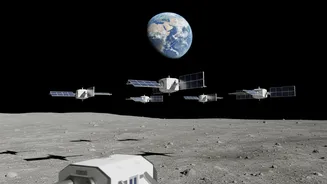
NASA's solution is to build a dedicated navigation and communications network for the Moon, often referred to as LunaNet. Instead of depending on Earth, this system will create a local infrastructure of services around and on the lunar surface. A key part of this vision involves deploying a series of beacons that act as fixed reference points. Evan Anzalone, the principal investigator for a key NASA navigation project, compared the concept to a network of lighthouses. These beacons, placed on landers or as standalone units, would provide a reliable signal that nearby assets—be they orbiting spacecraft, robotic rovers, or astronauts on foot—can use to calculate their position with precision. This approach shifts navigation from a system dependent on Earth to one that is local and autonomous, enabling quicker and more accurate positioning for all lunar activities.
Introducing Lunar Node-1
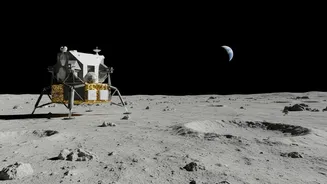
The first major test of this lighthouse concept was the Lunar Node-1 (LN-1) payload. Developed at NASA's Marshall Space Flight Center, LN-1 is a CubeSat-sized radio beacon designed specifically to test autonomous navigation. It travelled to the Moon in early 2024 as part of the payload on Intuitive Machines' IM-1 mission, which landed the Odysseus spacecraft near the lunar south pole. The primary goal of LN-1 was not to be a permanent part of the network, but to serve as a crucial technology demonstrator. During its journey and after landing, the payload transmitted its position and timing data, which was received by NASA's Deep Space Network on Earth to verify its performance. Despite a challenging landing orientation for the lander, the LN-1 team successfully conducted its experiment, proving the core technology could work in the harsh lunar environment.
How It Provides a Fix
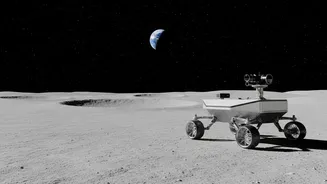
The LN-1 payload functions by broadcasting a navigation signal that other systems can detect. By receiving this signal from a known, fixed point on the lunar surface, a user—like a future astronaut's helmet heads-up display or a rover's guidance system—can perform a series of calculations to determine its own position, velocity, and time. This is achieved without having to send a signal all the way back to Earth and wait for a response. The system uses a specialized software called the Multi-spacecraft Autonomous Positioning System (MAPS), which enables different assets to effectively talk to each other to figure out where they are. By demonstrating this capability, LN-1 paved the way for future versions that will be more powerful and form a true, interconnected network, much like how cell towers work together on Earth to provide seamless coverage.
Paving the Way for Artemis
This technology is not just an engineering exercise; it is a fundamental enabler of NASA's Artemis program, which aims to establish a long-term human presence on the Moon. Reliable, real-time navigation is critical for nearly every aspect of future missions. It's needed for the precision landing of cargo and crewed vehicles, for astronauts to safely explore areas far from the landing site, and for coordinating the construction of a future Moon base. The success of LN-1 and follow-on technologies, like the NavCube3-mini receiver recently delivered for a lunar relay satellite, are critical steps. They are building the foundational infrastructure that will allow lunar exploration to move beyond short, Apollo-style visits and into an era of sustained scientific research and habitation on another world.