




The Galaxy’s Quiet Giant
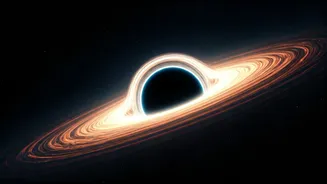
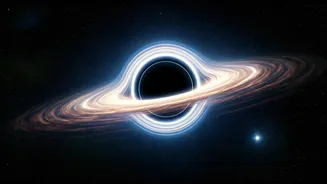
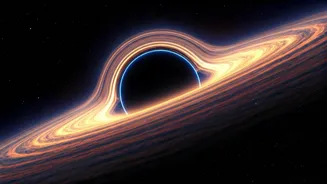
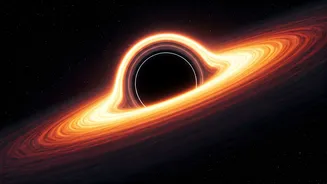
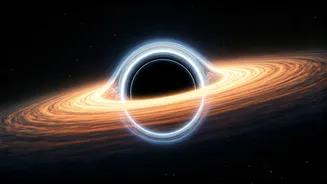
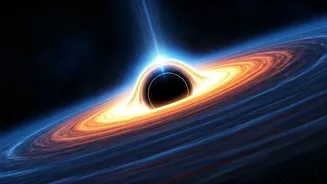
Sagittarius A, or Sgr A for short, is the supermassive black hole at the center of our galaxy, located about 27,000 light-years from Earth. While it has a mass equivalent to over four million Suns, Sgr A is considered a relatively quiet and gentle giant
compared to the voracious black holes seen at the centers of other galaxies. Astronomers have long known it's there, thanks to the way it pulls on nearby stars, forcing them into swift orbits. In 2022, the Event Horizon Telescope collaboration even gave us our first direct image of its shadow. But one key feature that theory predicted has remained stubbornly hidden for half a century.
The 50-Year Search for a Missing Wind
Physics dictates that as black holes pull in gas and dust, they should also produce an outflow, or a 'wind', that pushes material away. This happens because the material being consumed gets super-heated and accelerated, generating energy that blasts some of that material back out into space. This phenomenon has been observed in many active galaxies, but never from our own Sgr A. Its apparent lack of a wind was a persistent puzzle. Was our black hole somehow different? Or was something obscuring our view? This mystery has puzzled astronomers for more than 50 years.
The 'Aha!' Moment
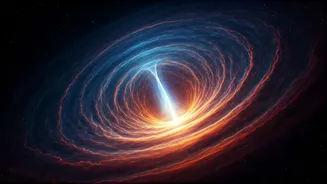
Now, a team of researchers from Northwestern University says they have finally found it. By using new, highly detailed observations from the Atacama Large Millimeter/submillimeter Array (ALMA) in Chile, they were able to create the sharpest map yet of the cold gas surrounding the black hole. When they looked at the data, they saw something remarkable: a giant, cone-shaped cavity in the gas, about three light-years long, pointing directly away from Sgr A. This empty space was the unmistakable imprint of a wind blowing from the black hole, carving out a path through the surrounding gas. As one researcher put it, "We looked at the data and said, 'There it is. There is the thing that everybody's been looking for for 50 years.'"
How They Found the Clue
Finding this wind was incredibly difficult. Sgr A is relatively dormant, consuming very little material—the equivalent of a single grain of rice every million years for a human. This means its wind is not very powerful. Furthermore, to see it from Earth, astronomers have to peer through thousands of light-years of our galaxy's dense and dusty plane. The breakthrough came from combining years of ALMA radio telescope data with X-ray data from NASA's Chandra X-ray Observatory. The ALMA data showed the empty cavity in the cold gas, while the Chandra data showed that this same cavity was filled with hot gas—the clear signature of a black hole-powered outflow.
What This Discovery Means
Confirming the existence of this wind, which is estimated to have been blowing for at least 20,000 years, is a major step forward. It shows that Sgr A, despite its quiet nature, is not an exception to the rules of black hole physics. It behaves just like its more active cousins in other galaxies, only on a much smaller scale. This discovery provides a crucial window into the typical, quiet state of most supermassive black holes in the universe. It helps us understand how these cosmic engines interact with their home galaxies, regulating gas and influencing the environment around them over millions of years. This finding proves that our place in the universe, and our home black hole, is not unique.