






A Landmark Project in Green Automotive Production
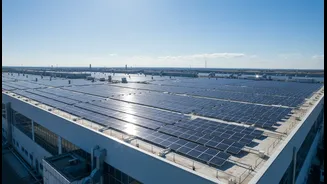
Volkswagen has successfully integrated one of Europe's largest 'behind-the-meter' on-site solar installations at its Crafter van factory in Września, near Poznan. The massive photovoltaic (PV) farm is now operational, generating enough clean energy to cover
approximately 25% of the plant's total annual electricity demand. On particularly sunny days, the solar array has proven capable of powering the entire factory's operations, marking a first for the facility and a significant achievement in industrial decarbonization. Developed in partnership with renewables specialist Quanta Energy, the project underscores a tangible commitment to reducing the carbon footprint of vehicle production.
The Sheer Scale of the Solar Installation
To understand the scope of this initiative, one has to look at the numbers. The completed solar farm has a total capacity of 18.3 megawatts (MW) and consists of over 31,000 individual solar panels. These panels are spread across an area equivalent to nearly 38 football pitches. The supporting structure alone weighs over 430 tonnes, comparable to a Boeing 747, and the system required 150 kilometres of cabling to integrate. This extensive setup allows the plant to generate a significant portion of its own power directly on-site, reducing reliance on the external grid and providing stability against fluctuating energy prices. The project was completed in several phases, with the final expansion bringing it to its current impressive capacity.
Powering an Energy-Intensive Operation
Automobile manufacturing is an incredibly energy-intensive process. From the stamping of metal body panels and the precision of robotic welding to the multi-stage painting and drying processes, every step requires a vast and consistent supply of electricity. The Poznan factory has an annual production capacity of up to 100,000 vehicles, including both conventional and the all-electric e-Crafter models. Meeting 25% of this demand with solar power is therefore a monumental achievement that sets a new standard for the industry. It demonstrates that even large, heavy-industrial facilities can make substantial progress in transitioning to renewable energy sources.
A Core Part of Volkswagen's 'goTOzero' Strategy
This solar farm is not an isolated project but a key component of Volkswagen's broader environmental mission, known as 'goTOzero'. The corporate-wide strategy aims to make the company net carbon-neutral by 2050, in line with the Paris Climate Agreement. The 'goTOzero' framework focuses on four main areas: climate change, resource conservation, air quality, and environmental compliance. By generating its own green electricity, the Poznan plant directly addresses the goals of climate action and resource efficiency. The company has stated its intent to achieve climate-neutral production at all manufacturing sites by 2040, with the Polish plants playing a pioneering role.
More Than Just Green Energy
The innovation at the Poznan site extends beyond electricity generation. In a unique initiative combining renewable energy with agriculture—a practice known as agrivoltaics—Volkswagen has hired a flock of 100 sheep to manage the vegetation growing under the solar panels. This natural approach to lawn maintenance eliminates the need for fossil-fuel-powered mowers, further reducing emissions and noise pollution. The project is also a scientific study in partnership with the Poznań University of Life Sciences, examining how the sheep affect biodiversity and soil quality, and whether the shade from the panels reduces heat stress for the animals. It shows how modern industry can be integrated with nature.