



What Are Hanging Glaciers?
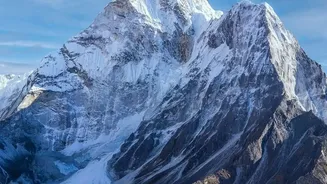
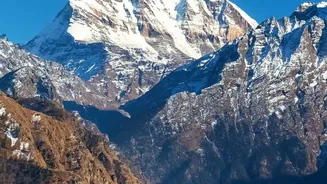
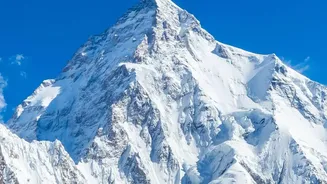
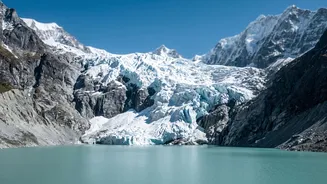
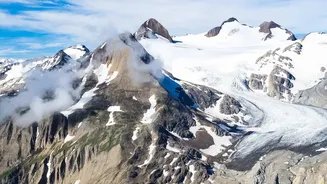
Unlike the vast river-like glaciers that crawl slowly through valleys, hanging glaciers are smaller bodies of ice that cling precariously to steep mountain slopes and cliff edges. They originate high on the walls of glacial valleys and stop abruptly,
often at a cliff face. Because they are not supported by a gentle valley floor, their only way down is to break off. This inherent instability is their defining characteristic. An ongoing assessment has identified at least 858 such glaciers across India's Himalayan range, from the Yamuna basin to the Kali basin.
A Warming Climate's Deadly Push
The primary driver of this escalating threat is climate change. The Himalayas are warming faster than the global average, leading to accelerated ice melt. This warming weakens the glaciers in several ways. The cycle of freezing and thawing can create fractures within the ice over time. Furthermore, meltwater can seep into cracks and lubricate the bedrock beneath the glacier, making it more likely to detach from the steep slope it rests upon. This instability transforms these ice masses into potential time bombs, with rising summer temperatures significantly increasing the danger.
The Cascade of Catastrophe
The collapse of a hanging glacier triggers a terrifying and rapid chain reaction known as a multi-hazard cascade. First, a massive chunk of rock and ice breaks off, creating a powerful avalanche that hurtles down the mountain. This avalanche can travel at incredible speeds. If this mass of ice and rock crashes into a river or a glacial lake below, it can create a sudden, massive displacement wave. This can cause the natural dam of a glacial lake—often made of loose rock and sediment—to burst. The result is a Glacial Lake Outburst Flood (GLOF), a devastating torrent of water, mud, and boulders that surges downstream, destroying everything in its path.
India's Vulnerable Himalayan States
For India, this is not a distant, theoretical threat. The 2021 Chamoli disaster in Uttarakhand was a tragic real-world example of this phenomenon. A huge section of rock and ice, including part of a hanging glacier, broke away from Ronti Peak. The resulting debris flow killed over 200 people and obliterated two hydropower projects. Recent studies have sounded specific alarms for the region. One study published in 'Nature' identified 219 hanging glaciers in Uttarakhand's Alaknanda basin alone. Simulations based on this research suggest that an avalanche flow in the Badrinath-Mana sector could exceed 50 metres in height, capable of overwhelming major settlements and infrastructure.
A Race Against Time for Monitoring
The growing danger has spurred action. Following a recent deadly glacial collapse on the Tibet-Nepal border, Indian authorities, particularly in Uttarakhand, have intensified the monitoring of glaciers and glacial lakes. The state has identified 13 particularly sensitive lakes for close observation and plans to install state-of-the-art early warning systems. Scientists are pushing for the expanded use of satellite-based, real-time monitoring to track changes in these remote and challenging environments. Such systems could provide crucial advance notice, offering communities downstream precious time to evacuate. This underscores an urgent need for systematic risk identification, continuous monitoring, and climate-resilient land-use planning to protect the millions of people living in the shadow of these icy giants.