




Meet NASA's Next Cosmic Explorer
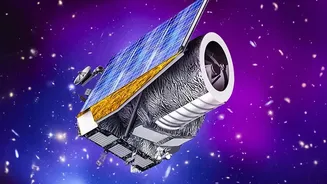
NASA has officially selected the PRIMA space telescope for the next phase of development. As the first in a new class of "Probe Explorers," PRIMA represents a significant investment in our ability to answer fundamental questions about the universe. With
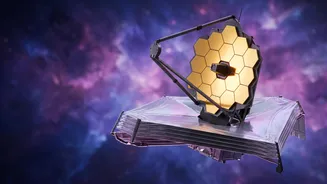
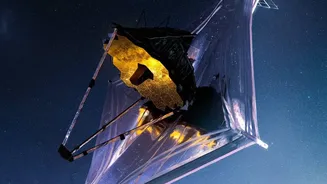
a proposed launch no earlier than 2033, this 1.8-meter telescope is designed to do something its predecessors cannot: conduct deep surveys of the cosmos in far-infrared light. Managed by NASA's Jet Propulsion Laboratory, the mission carries a cost cap of around $1.2 billion and aims to operate for at least five years. Its goal is to bridge a critical gap in our observational capabilities, complementing the work of missions like the James Webb Space Telescope (JWST) and ground-based radio observatories.
The Universe's Hidden Wavelength
Imagine the light from the universe as a vast spectrum, far greater than the rainbow of colors our eyes can see. Telescopes are designed to see specific parts of this spectrum. JWST is a champion of the near- and mid-infrared, while radio arrays like ALMA excel at capturing long radio waves. But between them lies a crucial blind spot: the far-infrared. This portion of the spectrum is essential for observing phenomena that are too cold to glow in visible or even mid-infrared light. Earth's atmosphere blocks this light, making a space-based observatory necessary. PRIMA is being built specifically to master this domain, with detectors so sensitive they must be cryogenically cooled to just a few degrees above absolute zero to suppress their own heat.
Why We Must See in Far-Infrared
So, what secrets are hiding in this far-infrared gap? This is the light emitted by the universe's coldest building blocks. It allows astronomers to peer into the dense, dusty clouds where new stars and planets are born—areas completely opaque in visible light. Far-infrared light can effectively bypass cosmic dust, revealing the processes hidden within. This unique vision will allow PRIMA to address a wide range of cosmic mysteries. According to Nicky Fox, associate administrator at NASA, the mission will help us better understand how planets, stars, and black holes form and evolve.
Tracing the Path of Cosmic Water
One of PRIMA's most compelling targets is water. This simple molecule is a key ingredient for life as we know it, and astronomers want to understand its journey across the cosmos. While JWST can spot water vapor in the hot, inner regions of planet-forming disks, many key spectral signatures for water ice and its distribution exist only at far-infrared wavelengths. PRIMA will be able to map water from the interstellar clouds where it originates to the protoplanetary disks where new worlds are assembling. This will provide unprecedented insight into how much water is available for forming planets and how it gets delivered to them, including how it may have arrived on Earth.
Searching for Echoes of the Big Bang
Beyond star formation, PRIMA is also designed to hunt for evidence of one of the most significant events in cosmic history: inflation. This is the theory that the universe underwent a period of hyper-fast expansion just a fraction of a second after the Big Bang. This event would have sent gravitational waves rippling through spacetime, leaving a faint, twisting pattern, known as B-mode polarization, in the Cosmic Microwave Background (CMB)—the afterglow of the Big Bang. Detecting this signal would be a monumental, Nobel-worthy discovery, confirming a cornerstone of modern cosmology. PRIMA's sensitivity would give scientists one of their best chances yet to find this elusive cosmic fingerprint.