




Fresh Evidence from a New Place
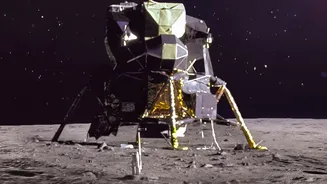
For over 40 years, our entire physical understanding of the Moon’s history was based on rocks brought back by the American Apollo and Soviet Luna missions. These samples, collected from the Moon's near side, were revolutionary. But now, new samples from China's
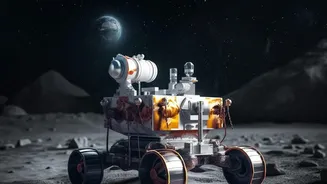
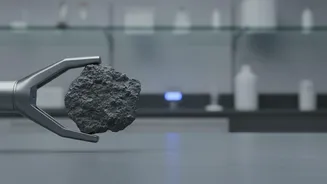
recent lunar missions, including Chang'e-5 and Chang'e-6, are providing a fresh perspective. The Chang'e-5 mission, for instance, collected rocks from a much younger volcanic region than any Apollo site. Analysis showed these basalts were only 2 billion years old, proving the Moon was geologically active for hundreds of millions of years longer than previously thought. More recently, the Chang'e-6 mission accomplished a historic first: returning samples from the Moon’s far side, a hemisphere that perpetually faces away from Earth. This is crucial because the far side offers a cleaner, less contaminated record of ancient events.
The Cosmic Cataclysm in Question
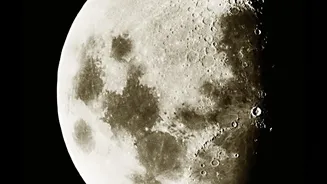
A central theory shaped by the Apollo samples is the "Late Heavy Bombardment" or "Lunar Cataclysm." This idea proposes that around 3.9 billion years ago, the inner solar system was subjected to a sudden and intense spike in asteroid and comet impacts over a relatively brief 200-million-year period. The evidence was a curious clustering of impact ages around that time found in the Apollo rocks. Because geological processes have erased this record on Earth, the Moon's surface was our best evidence for this violent chapter. However, scientists have long debated this theory, with some arguing the Apollo samples might have been biased, potentially all originating from the debris of a single massive impact that formed the Imbrium Basin on the near side.
What the Far Side Rocks Reveal
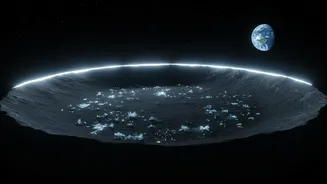
The new samples from the Moon's far side, collected from the South Pole-Aitken basin, are challenging the cataclysm theory directly. Analysis of these rocks, published in mid-2026, does not show a dramatic spike in impacts 3.9 billion years ago. Instead, the data points to a long, steady decline in bombardment that began much earlier, around 4.3 billion years ago. Researchers found a wide range of impact ages spread across billions of years, suggesting the solar system's early chaos wasn't a brief storm but a prolonged period of tapering violence. This new evidence suggests that the Late Heavy Bombardment may have been less of a solar-system-wide event and more of a perception created by the limited, debris-contaminated samples from the near side.
A More Complex Lunar History
This doesn't mean the old theories are completely wrong, but it does mean the story is far more complex. The Moon's history wasn't uniform; different regions experienced different timelines of volcanic activity and impacts. The Chang'e-5 samples proved that volcanism persisted much later than assumed, driven by a heat source that is still not fully understood. Now, the Chang'e-6 samples suggest the impact history was also more gradual. Rather than a single, simple answer, the new evidence paints a picture of a dynamic and varied lunar evolution. It forces scientists to recalibrate the models used to date surfaces not just on the Moon, but also on Mars and Mercury, as these models relied heavily on the Apollo-era timeline.