





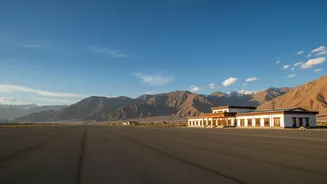


A Gateway in the Himalayas
Kushok Bakula Rimpochee Airport (IXL) in Leh is one of the highest commercial airports in the world, situated at a breathtaking altitude of 3,256 meters (10,682 feet). It serves as the primary airlink for Ladakh, a region known for its stunning landscapes,
unique culture, and strategic importance. For years, the airport has been a critical lifeline, not just for the burgeoning tourism industry that forms the backbone of the local economy, but also for the movement of military personnel and supplies. However, with a surge in tourist footfall and growing strategic needs, the existing infrastructure has been stretched to its limits, prompting the Airports Authority of India (AAI) to embark on a massive expansion and modernisation project. The foundation stone was laid in early 2019, kicking off a complex construction process in one of the world's most challenging environments.
Inside the State-of-the-Art Terminal
The centerpiece of this modernisation is a new, centrally air-conditioned integrated terminal building. Spanning approximately 19,000 square meters, the facility is designed to dramatically increase the airport's capacity. Once completed, it will be able to handle 3.5 million passengers annually, a significant jump from the 1.5 million currently managed. The peak hour passenger capacity will also see a major boost. Recent reviews of the project in mid-2026 noted that major structural works are complete, with interior finishing and equipment installation now in full swing. The new terminal will feature 18 to 20 check-in counters, modern baggage handling systems, multiple aerobridges to reduce boarding times, and enhanced passenger amenities like lounges and retail spaces designed to showcase local handicrafts. According to officials, the expanded airport will be able to handle up to 54 flights a day, nearly tripling its current capacity of around 18 daily flights.
Engineering Marvels and Green Initiatives
Constructing a modern facility at such a high altitude, where the working season is limited by extreme weather, is a significant engineering feat. A standout feature of the new terminal is its commitment to sustainability. It is set to be one of India's first airports to be powered by a hybrid system of geothermal and solar energy. An innovative geothermal heating system, one of the largest of its kind for an Indian airport, will use ground-source heat pumps to provide energy-efficient heating and cooling, which is crucial in Ladakh's harsh climate. This will drastically reduce the airport's carbon footprint. The architectural design is another highlight, thoughtfully created to reflect Ladakh's rich cultural heritage. Its form is inspired by the region's traditional Buddhist philosophy and stupas, blending modern infrastructure with ancient wisdom.
Boosting Tourism and Strategic Might
The impact of this project extends far beyond the airport's boundaries. For Ladakh's tourism-dependent economy, the new terminal is a game-changer. Enhanced capacity and improved passenger experience are expected to significantly boost tourist arrivals, providing greater flexibility for visitors and supporting local livelihoods. The upgrade will position Ladakh as a more accessible and sought-after destination for both domestic and international travellers. Strategically, the airport's modernisation is vital. Located near India's northern borders, an efficient and high-capacity Leh airfield enhances the nation's operational capabilities for both civil and military purposes. The project includes not only the new terminal but also an expansion of the apron with additional aircraft bays, which will improve aircraft movement and turnaround times. This strengthens Ladakh's ability to support humanitarian assistance and disaster relief operations during emergencies.