






Meet the Roman Space Telescope
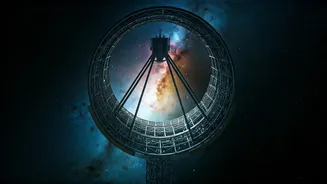
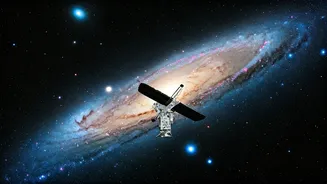
Set to launch no earlier than August 2026, the Nancy Grace Roman Space Telescope is NASA's next flagship astrophysics mission. Named after Nancy Grace Roman, NASA's first Chief of Astronomy and the 'mother of Hubble', this observatory is designed with
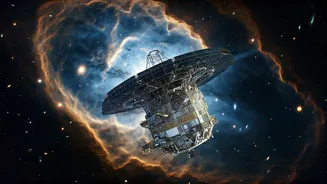
a specific purpose: to conduct massive surveys of the universe. While iconic telescopes like Hubble and James Webb provide exquisitely detailed but narrow views, Roman is built for breadth. It has a primary mirror the same size as Hubble's (2.4 meters), but its key innovation is a camera that can see a much larger patch of the sky at once. This makes it a perfect complement to its deep-diving cousins.
A Panoramic View of the Cosmos
Roman's primary tool is the Wide Field Instrument (WFI), a groundbreaking 300-megapixel camera. This instrument gives Roman a field of view 100 to 200 times greater than Hubble's infrared camera. In practical terms, a single image from Roman will contain the detail of 100 Hubble images. This incredible efficiency means Roman can map the sky at a blistering pace, collecting data about 1,000 times faster than Hubble. What might take Hubble thousands of years to observe, Roman could accomplish in just one year. This ability to generate enormous, high-resolution panoramas of the universe will transform how astronomers study the cosmos, moving from detailed portraits of individual objects to sweeping statistical studies of billions of them.
Chasing the Universe's Biggest Mysteries
The primary science goals for this powerful survey capability are ambitious. Roman will tackle two of the most profound puzzles in modern physics: dark energy and dark matter. By mapping the distribution of billions of galaxies across cosmic time, astronomers will be able to measure how the universe's expansion has changed, providing crucial clues about the nature of the mysterious dark energy that is causing this expansion to accelerate. Its wide-angle lens will also map how matter, including invisible dark matter, is structured throughout the cosmos.
A Census of Alien Worlds
Beyond cosmology, Roman is poised to revolutionize the hunt for exoplanets. It will conduct a massive survey of the inner Milky Way, using a technique called gravitational microlensing. This method is sensitive enough to detect planets with masses as small as Mars, including 'rogue' planets that don't orbit a star. Scientists expect Roman to discover thousands of new exoplanets, creating a vast statistical census of planetary systems in our galaxy. In addition, Roman is equipped with a Coronagraph Instrument, a technology demonstration designed to block the overwhelming glare of a star, which will allow for the direct imaging of giant exoplanets for the first time with this level of technology.
The Price of a New Perspective
A flagship mission with such transformative potential comes with a significant investment. The total lifecycle cost is estimated to be around $4.3 billion, which includes development, launch, and five years of operations. This price tag reflects the decade of development and the cutting-edge technology packed into the observatory, from its massive 18-detector camera to the advanced coronagraph. The project is a massive undertaking involving thousands of engineers and scientists. The primary mirror itself was a repurposed asset, originally built for the National Reconnaissance Office and donated to NASA, which helped constrain costs on that major component. For this investment, humanity gets an observatory capable of creating unprecedented maps of the universe and generating terabytes of new data every single day.