

The Final Hurdle: Safety First
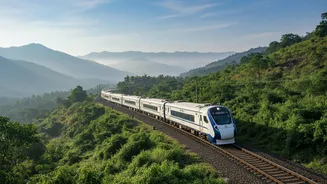
The South Western Railway's Mysuru Division is currently conducting extensive field trials for the new Vande Bharat service. These tests, which began around August 12 and are expected to continue for several days, are not a mere formality. They are a critical
safety assessment to ensure the semi-high-speed train can operate flawlessly on the treacherous ghat section between Sakleshpur and Subrahmanya Road. A specially built 20-car Vande Bharat rake, equipped with an Automatic Emergency Braking (AEB) system, was dispatched from the Integral Coach Factory in Chennai specifically for these trials. Officials have confirmed that the launch of regular passenger services is entirely dependent on the successful analysis of the data collected during these runs.
A Major Engineering Challenge
So, what makes this 55-kilometre stretch of track so difficult? The Sakleshpur-Subrahmanya section, which cuts through the Western Ghats, is an engineering marvel and a logistical nightmare in one. It features a steep gradient of 1 in 50, meaning the track rises one metre for every 50 metres travelled. Compounding this are 57 tunnels, 226 bridges, and 108 sharp curves packed into this short distance. The area is also highly susceptible to landslides, especially during the monsoon, and much of the track is inaccessible by road, making maintenance and emergency access incredibly challenging. Due to these factors, the Commissioner of Railway Safety has historically capped speeds at just 30 kmph on this stretch, highlighting the need for rigorous testing for a faster train like the Vande Bharat.
What the Trials are Measuring
Personnel from the Research Designs and Standards Organisation (RDSO) are on board during the trials to monitor a host of technical parameters. They are collecting data on the train's acceleration, stability, and braking performance, particularly on the steep inclines and sharp turns. A key focus is the effectiveness of the Automatic Emergency Braking (AEB) system, a crucial safety feature for this route. The AEB system can automatically apply the brakes if it detects an unsafe speed, reducing the risk of accidents on the steep gradients. Unlike conventional trains that use additional 'banker' locomotives to push them up the ghats, the Vande Bharat is designed to navigate such terrain on its own power, a capability that must be proven safe and reliable here.
The Payoff for Passengers
Once these trials are successfully completed and the necessary safety clearances are obtained, the benefits for travellers will be immense. The entire Bengaluru-Mangaluru rail line is already fully electrified, a major milestone completed in late 2025 that paved the way for faster, more efficient train services. The Vande Bharat Express is expected to significantly reduce travel time between the state capital and the vital coastal hub, offering a faster alternative to existing trains and road transport. This improved connectivity will be a major boon for business, tourism, and daily commuters, seamlessly linking the tech capital with the coastal region. While an exact launch date has not been announced, the completion of these trials is the last major technical obstacle before the service can be scheduled.