



SpaceX recently won regulatory approval for a startlingly ambitious plan: a network of up to one million satellites. While proponents see a new frontier for AI and data, astronomers see a potential catastrophe for science and our shared view of the stars.
A Million Satellites? Not Just SpaceX
The headline-grabbing number of one million satellites comes from a specific US Federal Communications Commission (FCC) approval for a SpaceX project called 'Starmind'. This system is designed to be a network of orbiting data centres, intended to meet the massive demand for AI computing power. However, the 'million-satellite' figure is more than just one company's plan; it represents the cumulative ambition of a new space race. International Telecommunication Union filings reveal proposals from multiple countries and companies that, in total, account for over a million planned satellites. To put this in perspective, since 1957, humanity has launched around 28,000 satellites in total; as of late 2026, only about 17,000 are active. SpaceX’s existing Starlink network, which provides internet services, already consists of over 11,000 satellites and has plans to expand to 100,000. These massive groups of coordinated satellites are known as 'mega-constellations'.
The Problem of a Crowded Sky
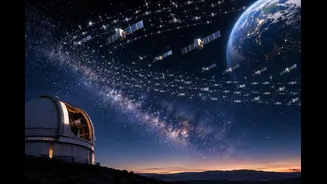
The primary concern for astronomers is light pollution. Satellites in low-Earth orbit are not intrinsically bright, but they become highly reflective objects when sunlight catches their surfaces, especially around dusk and dawn. For ground-based telescopes capturing long-exposure images of faint, distant galaxies, these satellites create bright streaks that can ruin years of work. The American Astronomical Society (AAS) has expressed dismay, stating these constellations could undermine decades of investment in astronomical facilities. The problem isn't limited to Earth; space telescopes like the Hubble are also affected, as many satellites orbit above them. One study projected that if all currently proposed constellations are completed, a third of Hubble images could be contaminated.
More Than Just Pretty Pictures
The interference goes beyond optical astronomy. Satellites are a source of significant 'noise' for radio astronomy. They transmit and receive signals that can easily overwhelm the incredibly faint radio waves from cosmic objects that radio telescopes are designed to detect. This is critical because radio telescopes are used for more than just imaging; they help track objects to measure Earth’s rotation, which is essential for the accuracy of navigation systems like GPS. Furthermore, the heat generated by orbiting data centres could create an infrared thermal signature, raising the background 'glow' of the sky and making it harder to distinguish faint objects in infrared observations. This combined assault on the electromagnetic spectrum threatens to blind scientists to vast swathes of the universe.
The Threat of Space Junk
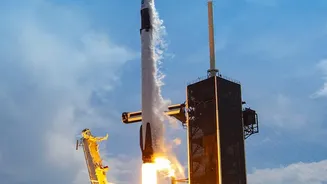
A more congested low-Earth orbit dramatically increases the risk of collisions. A crash between two satellites at orbital speeds can create thousands of pieces of lethal debris. Scientists have long worried about a chain reaction known as the 'Kessler Syndrome', where debris from one collision triggers more, eventually rendering entire orbital bands unusable for generations. With plans for hundreds of thousands of new satellites from companies like SpaceX, Amazon's Leo, and OneWeb, the orbital environment is becoming dangerously crowded. Each satellite has a limited lifespan, typically around five years, requiring constant replenishment and increasing the number of defunct objects and launch-related atmospheric pollution.
Can a Compromise Be Reached?
To its credit, SpaceX has acknowledged the concerns and has been working with astronomical groups to find solutions. Early efforts included 'DarkSat', an experimental satellite with a special anti-reflective coating that reduced its brightness by about 55%. While an improvement, it wasn't enough. The next iteration was 'VisorSat', which equipped satellites with a sun visor to block light from reaching the most reflective parts. More recent efforts involve using advanced mirror films and darker materials to mitigate brightness. However, many astronomers feel these measures are insufficient for the sheer scale of the proposed networks. The AAS and other international bodies are calling for stronger regulations and a more coordinated global approach to managing space, arguing that the night sky is a shared resource for all humanity.