







A Most Unlikely Ocean
For most of human history, Pluto was little more than a faint speck of light in our most powerful telescopes. Even after its discovery, scientists assumed it was a dead, frozen relic, geologically inactive for billions of years. With surface temperatures
plummeting to around minus 220 degrees Celsius, it’s a world where nitrogen freezes solid and water ice becomes as hard as rock. The idea of liquid existing in such a profoundly cold environment seemed impossible. But when NASA’s New Horizons spacecraft flew past the dwarf planet in 2015, it sent back images that turned all those assumptions on their head. The probe revealed a surprisingly complex and active world, with vast glaciers, towering mountains of water ice, and a young surface that hinted at ongoing geological processes.
Volcanoes of Ice and Nitrogen Flows
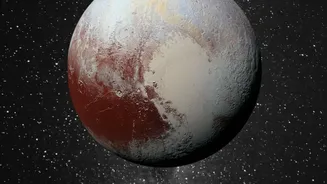
Among the most startling discoveries were features that look remarkably like volcanoes. But instead of spewing molten rock, these cryovolcanoes, as they are called, are thought to erupt an icy, slushy mixture from below. Structures like the massive Wright Mons, a mountain about 150 kilometres across, show depressions at their peaks, consistent with volcanic activity. More recent analysis has focused on Pluto's famous heart-shaped region, a vast nitrogen glacier called Sputnik Planitia. Researchers noticed dark, linear streaks and patches along the northern edge of this glacier. By comparing these features to similar ones on Earth's own ice sheets in Greenland, scientists concluded that the marks on Pluto are consistent with a liquid that has welled up from beneath the ice and stained the surface. This represents the first evidence of recently flowing liquid on Pluto.
A Recipe for Liquid
So how can liquid exist on such a frigid world? The answer appears to lie in two key factors: a hidden heat source and a natural antifreeze. While Pluto’s surface is freezing, its core is thought to still retain some residual heat from its formation billions of years ago. This internal heat can melt the ice at the base of its thick glaciers. In the case of Sputnik Planitia, computer models suggest that the immense pressure at the bottom of the kilometre-deep nitrogen glacier can cause it to melt, forming liquid nitrogen. This liquid can then be forced up to the surface through cracks and fissures. In other parts of Pluto, the secret ingredient may be ammonia. The New Horizons probe detected ammonia mixed with water ice near the cryovolcanoes. Ammonia is a powerful antifreeze, drastically lowering the freezing point of water and making it possible for a salty, ammonia-rich ocean to remain liquid beneath Pluto’s icy shell.
Why a Frozen World Matters
The discovery that Pluto is a dynamic world with subsurface liquids fundamentally changes our understanding of where life’s ingredients might be found. For decades, the search for habitable worlds focused on the “Goldilocks zone” around stars, where temperatures are just right for liquid water to exist on the surface. Pluto proves that even in the solar system's coldest, darkest corners, internal heat and chemical composition can create hidden liquid environments. These findings suggest that a vast number of icy worlds throughout the galaxy, previously dismissed as frozen and inert, could potentially harbour subsurface oceans. While Pluto's liquid is often nitrogen, the evidence for a deep water-ammonia ocean remains compelling. This reframes our view of dwarf planets, suggesting they are not just static rocks but complex, evolving worlds that could be some of the most common habitats for liquid water in the universe.