





A 'Super-Jupiter' in a Young System
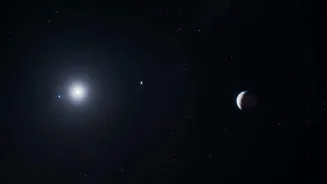
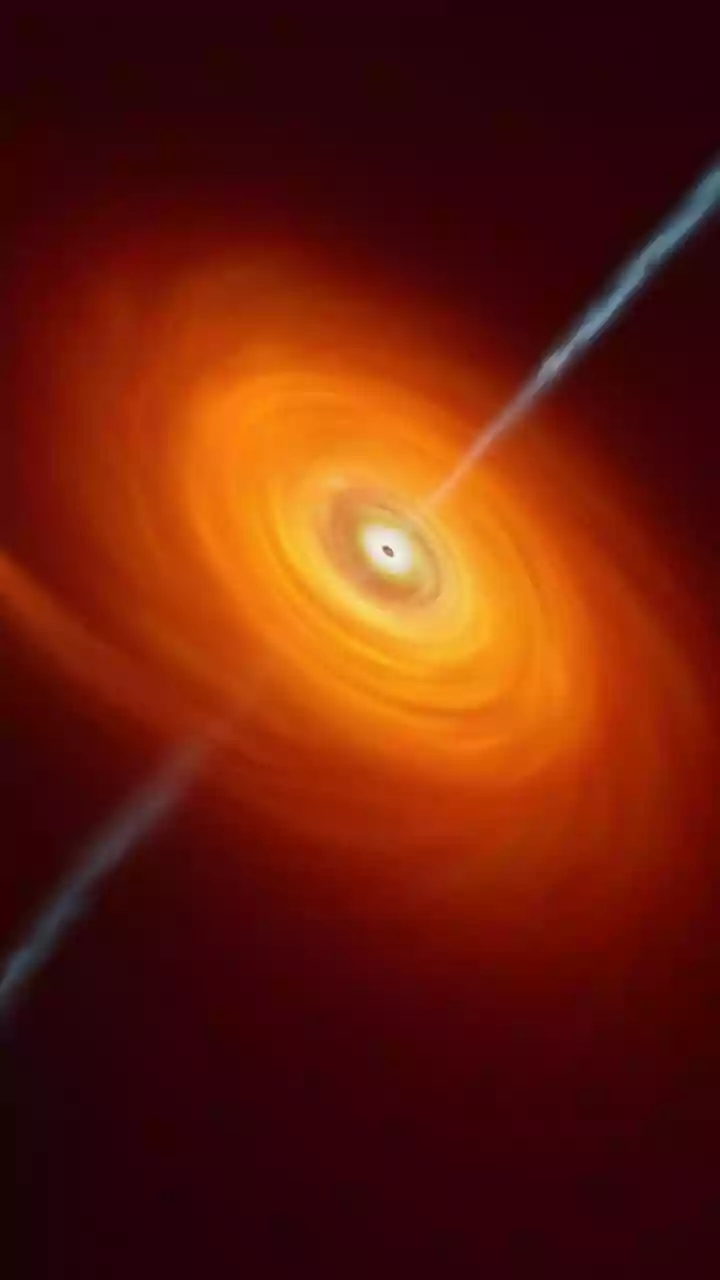
Imagine a star system in its infancy. Located about 63 light-years away, the Beta Pictoris system is just 20 to 23 million years old, a toddler compared to our 4.6-billion-year-old solar system. Orbiting this young star is Beta Pictoris b, a colossal
gas giant between nine and 13 times the mass of Jupiter. This 'super-Jupiter' was first discovered in 2008, but its youth and immense size have made it a perfect candidate for a new kind of planetary investigation: listening for its natural radio signals. Until now, trying to pick out a planet's faint radio whisper from the roar of its parent star has been a major challenge for astronomers.
Hearing the Planet's Magnetic Heartbeat
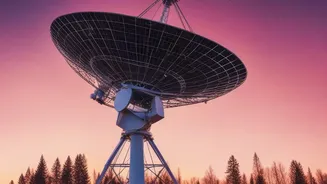
So, what did scientists hear? It wasn't aliens, but something almost as exciting. Using the powerful MeerKAT radio telescope array in South Africa, an international team of astronomers detected persistent, low-frequency radio waves coming directly from Beta Pictoris b. This is a landmark achievement, marking the first time a radio signal has been unambiguously traced back to an exoplanet. The signal is what's known as an 'auroral radio emission'. It’s the same type of natural broadcast produced by planets in our own solar system, including Earth, when charged particles interact with a magnetic field, creating spectacular auroras like the Northern Lights.
The Engine Behind the Broadcast
The secret to Beta Pictoris b's radio broadcast is its immense magnetic field. The radio waves allowed astronomers to calculate its strength for the first time, and the results are staggering. The planet's magnetic field is estimated to be thousands of times stronger than Earth's, and at least 200 times stronger than even Jupiter's, which boasts the most powerful magnetic field in our solar system. This powerful field is generated by the movement of electrically conductive fluid inside the massive, hot, and rapidly rotating young planet. As charged particles, likely from its star's solar wind, get trapped in this intense magnetic field, they spiral and accelerate, emitting powerful radio waves in a process called the electron cyclotron maser instability.
A New Window for Planet Hunters
This discovery does more than just add a new fact to the astronomical textbooks; it opens an entirely new field of study. By tuning into these radio frequencies, astronomers now have a new tool to not only detect giant exoplanets but also to characterize them in ways that were previously impossible. The properties of a radio signal can reveal the strength of a planet's magnetic field, give clues about its internal structure, and even help determine how fast it's spinning. One observation noted two radio bursts about eight hours apart, which could match the planet's rotation period. This is a profound shift from merely seeing these distant worlds to truly beginning to understand their physical nature.
Why Magnetic Fields Matter
While Beta Pictoris b is a gas giant and not a candidate for life, its powerful magnetic shield is a crucial piece of a larger puzzle. A strong magnetic field is believed to be a key ingredient for a planet’s long-term habitability. It protects the atmosphere from being stripped away by harsh stellar winds and shields the surface from harmful radiation. By learning how and when these massive magnetic fields form on giant planets, scientists can build better models for understanding the conditions on smaller, rocky, Earth-like worlds. The detection from Beta Pictoris b serves as a vital proof of concept, giving astronomers a specific signpost to look for in their ongoing search for planets that might have the right conditions to support life.