




India's Aditya-L1 is rewriting our understanding of the Sun. By pairing its advanced coronagraph with powerful 3D models, scientists are getting a revolutionary new look at solar eruptions, challenging long-held assumptions.
India’s Unblinking Eye on the Sun
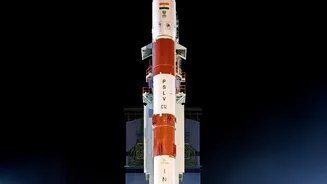
Launched in September 2023,
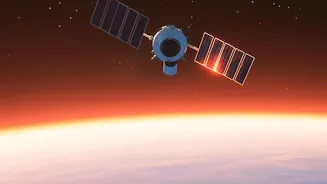
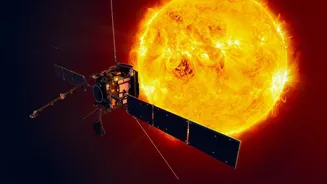
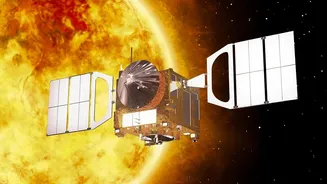
the Aditya-L1 is India’s first dedicated space-based solar observatory. Operated by the Indian Space Research Organisation (ISRO), the spacecraft is strategically positioned at Lagrange point 1 (L1), about 1.5 million kilometres from Earth. This unique vantage point allows it to watch the Sun continuously, without Earth blocking its view, making it a crucial tool for monitoring our star's behaviour. The mission carries seven sophisticated payloads designed to study everything from the Sun’s outer atmosphere (the corona) to the solar wind, the stream of charged particles flowing from the Sun. This comprehensive approach is key to understanding the interconnected processes that drive solar activity and space weather.
The Challenge of Seeing the Corona
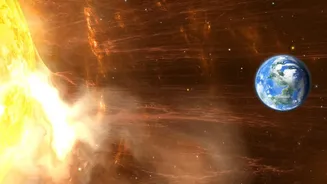
The Sun's corona is one of its biggest mysteries. This superhot outer atmosphere, with temperatures reaching millions of degrees, is paradoxically much hotter than the Sun's surface, which is only about 6,000 Kelvin. However, the corona is incredibly faint, making it impossible to see next to the blinding glare of the Sun's main disk. This is a major challenge for scientists who want to study phenomena like coronal mass ejections (CMEs)—massive eruptions of plasma and magnetic fields from the corona. When aimed at Earth, CMEs can disrupt satellites, communication networks, and even power grids, so understanding them is vital.
Peeking Behind the Glare with VELC
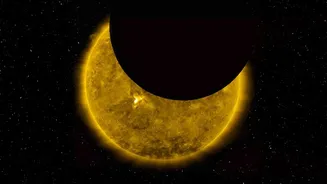
This is where Aditya-L1's primary instrument, the Visible Emission Line Coronagraph (VELC), comes in. Developed by the Indian Institute of Astrophysics (IIA), VELC is an internally occulted coronagraph. Think of it as creating a permanent, artificial solar eclipse. It has an internal mechanism that blocks the bright light from the Sun's disk, allowing the much fainter corona to be observed in unprecedented detail. But VELC does more than just take pictures. It's a spectrograph, meaning it can analyse the light from the corona to determine its properties, including the speed and direction of the plasma. It does this using the Doppler effect—the same principle that makes an ambulance siren change pitch as it moves towards or away from you.
From Flat Images to a 3D Reality
For decades, scientists largely assumed that CMEs expanded uniformly, like a symmetrical bubble. New data from Aditya-L1 has shattered that assumption. During a CME event on August 5, 2024, the VELC instrument detected something unusual: plasma moving both towards and away from the observer at the same time. To understand this, researchers from the IIA combined the VELC data with observations from NASA's Solar Dynamics Observatory (SDO) and fed it all into a powerful three-dimensional model. The result was a revelation. The model showed that a simple, uniformly expanding bubble couldn't explain what VELC was seeing. Only a model where the CME expanded unevenly, with an asymmetric shape and a tilt, could reproduce the data.
Why This Discovery Is a Game Changer
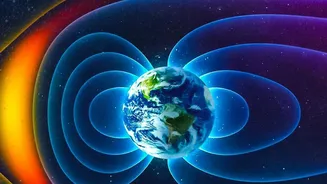
This discovery is more than just a scientific curiosity; it has major implications for space weather forecasting. The shape and expansion of a CME affect how it interacts with the solar wind and how much drag it experiences on its journey through space. An asymmetric eruption might travel at a different speed and arrive at Earth earlier or later than a symmetrical one would. By proving that CMEs can be lopsided, Aditya L1 s data gives forecasters a crucial new variable to consider, paving the way for more accurate predictions. This innovative technique of combining single point spectroscopy with 3D modelling provides a powerful new way to study eruptions, especially in their critical early stages near the Sun.