



More Than Just a Pretty Fireball
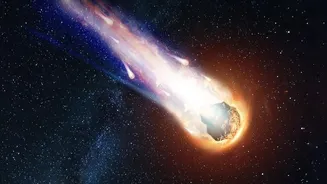
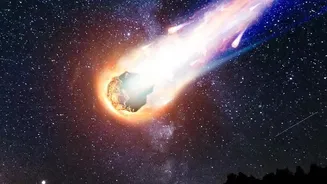
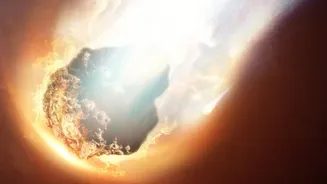
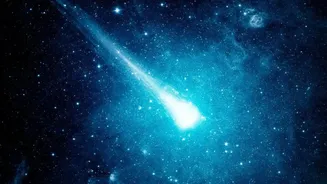
At first glance, it looks like countless other images of shooting stars: a brilliant streak of light tearing across the upper atmosphere. But this new data, captured by a suite of NASA's most advanced observational instruments, is different. It provides
an unprecedented, second-by-second breakdown of a meteoroid's final moments. The image and its associated data track the object's temperature, deceleration, and the exact way it shed energy. What it reveals is a process far more intense and complex than the simple idea of an object burning up from friction, and it has scientists re-examining long-held assumptions.
It's Not Friction, It's Compression
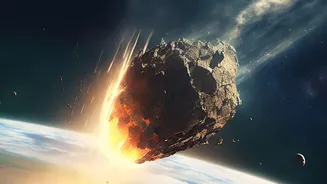
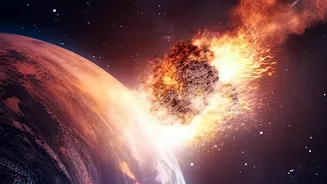
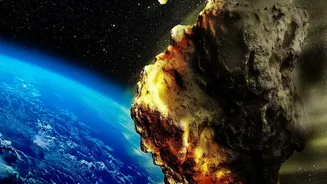
For decades, the common explanation for a meteor's glow has been friction with the air. It’s an intuitive idea, but scientifically, it’s not the main story. The real engine of a meteor's destruction is extreme air compression. As a meteoroid slams into the atmosphere at hypersonic speeds—often more than 50,000 kilometres per hour—it doesn't have time to push the air aside. Instead, it violently compresses the air in front of it, like a piston with no escape valve. This process, known as adiabatic compression, causes the air itself to heat up to thousands of degrees, hotter than the surface of the Sun. This superheated pocket of plasma is what incinerates the meteoroid in a process called ablation.
What the New Picture Changes
Previous models of this heating process were based on calculations and observations of smaller, more distant events. NASA's new, clearer data provides a much more precise measurement of the heat transfer efficiency—how effectively that superheated atmospheric plasma transfers its energy to the meteoroid. The initial findings suggest that this energy transfer is even more potent than many models had predicted. This means that objects entering the atmosphere may heat up faster and disintegrate more violently than previously thought. The data is giving scientists a better understanding of how different materials (rocky versus metallic asteroids, for example) behave under this extreme thermal stress, refining the computer models that are essential for predicting the outcome of any potential impact event.
The Big Decision: Deflect or Disrupt?
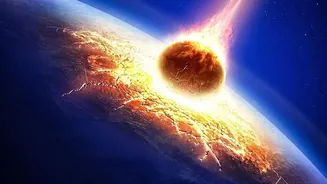
This brings us to 'the decision' at the heart of modern planetary defense. When faced with a near-Earth object (NEO) on a collision course, humanity will have two basic choices: deflect it or disrupt it. Deflection, as successfully demonstrated by NASA's DART mission, involves nudging the asteroid to change its orbit so it misses Earth entirely. Disruption is a more aggressive option: using a powerful impactor or a nuclear device to break the asteroid into many smaller, less threatening pieces. The idea is that these smaller fragments would then be small enough to safely burn up in the atmosphere.
Weighing the Atmospheric Shield
The disruption strategy hinges entirely on the atmosphere's ability to act as a shield. And this is precisely where the new data on atmospheric heating becomes so critical. If the heating process is more intense than we thought, it could mean the disruption strategy is more viable, as even slightly larger fragments might completely ablate. However, it also carries a significant risk. A more violent disintegration could cause a massive, simultaneous release of energy at high altitude, creating a devastating airburst with a shockwave capable of causing widespread damage on the ground. A better understanding of atmospheric heating allows planners to more accurately calculate the threshold for safe fragmentation, giving more weight to the decision-making process. It helps answer the crucial question: if we shatter an asteroid, are we creating a harmless meteor shower or a catastrophic aerial explosion?