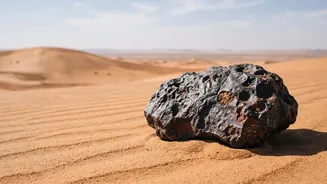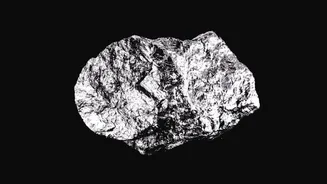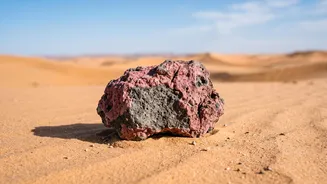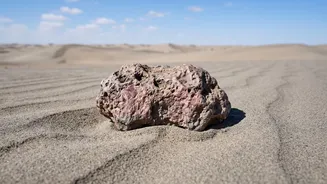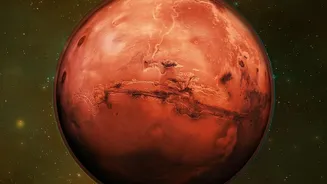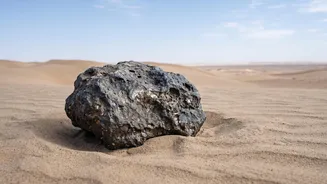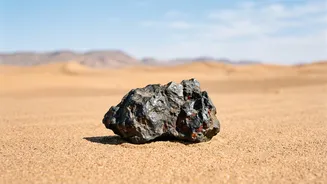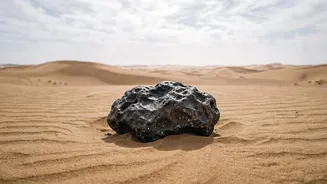





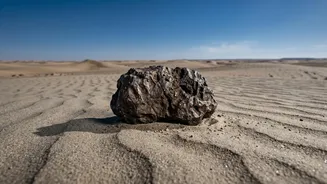

A rose-coloured rock found in the Sahara Desert is changing how we see Mars. Discovered in 2022, the Teghaza 001 meteorite is a 4.1-billion-year-old messenger from the Red Planet, offering an unprecedented look into its ancient past.
A Messenger From Another World
In 2022, meteorite
hunters came across eight fragments of a peculiar rock on the Teghaza salt plain in Mali. Weighing nearly 800 grams in total, the collection of stones, named Teghaza 001, was quickly identified as something special. Scientists confirmed it was a Martian meteorite, one of only about 435 ever found on Earth. These rocks are blasted off the Martian surface by asteroid impacts and drift through space, sometimes for millions of years, before falling to Earth. Researchers can verify their origin by analysing their chemical makeup and, crucially, by matching gases trapped inside the rock to the known composition of Mars's atmosphere, which was measured by probes like the Viking landers. What made Teghaza 001 truly exceptional, however, was its age. Dating revealed it formed over 4.1 billion years ago, making it one of the oldest pieces of Mars ever studied by humans.
The 'Rosetta Stone' of Mars
Not all Martian meteorites are created equal. Many are surprisingly young, geologically speaking, originating from more recent volcanic events. Teghaza 001, however, is ancient. It belongs to a group called shergottites, the most common type of Martian meteorite, but its age and unique mineral mix set it apart. Scientists at NASA's Jet Propulsion Laboratory were so struck by its potential that one reviewer dubbed it a 'Rosetta Stone for Mars'. Unlike other ancient Martian samples that are often composed of a single mineral, Teghaza 001 contains a complex assortment of igneous (volcanic) minerals. This diverse composition provides a much richer story, preserving evidence of multiple stages of the planet's early life, from the cooling of its magma to later alteration by water.
A More Complex Planetary Story
For years, a leading theory suggested Mars’s crust had a relatively simple origin: a global ocean of magma slowly cooled to form a uniform, basaltic shell. But recent discoveries, including analysis of Teghaza 001, are painting a more complex and dynamic picture. The meteorite's mineralogy suggests it formed underground from slowly cooling magma, a process that indicates a more evolved and multi-stage crust formation. Its composition also happens to be a perfect match for the terrain of Mars’s ancient southern highlands, a region observed by orbiters but never before sampled directly. This rock is the first physical piece scientists have from this primordial part of Mars, confirming that the planet's crust was not just a simple, single-layer shell but had regions with more complex geology.
Clues from Water and Time
Beyond its initial formation, Teghaza 001 holds another secret: its interaction with water. Detailed analysis of its zircon crystals—tiny, durable minerals that act as geological clocks—revealed that the rock was chemically altered by water around 4.1 billion years ago. This finding is significant because it pushes back the timeline for an active water cycle on Mars, suggesting it was a wet planet much earlier than previously thought. The evidence contained within this single rock shows a dynamic early Mars, where cooling magma formed a complex crust that later interacted with subsurface water. This provides a crucial link between the planet’s volcanic beginnings and its later, wetter period, a key focus for scientists searching for signs of past habitability.