





A Mission to Two Martian Mysteries
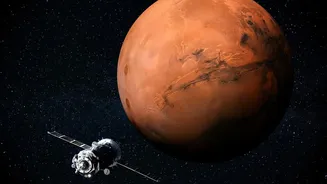
The Japan Aerospace Exploration Agency (JAXA) launched its Martian Moons eXploration (MMX) spacecraft on October 20, 2026, from the Tanegashima Space Center. This marked the beginning of a daring journey to orbit, study, and land on the moons of Mars.
The spacecraft is now on a year-long cruise to the Red Planet, expected to arrive in August 2027. For about three years, it will meticulously survey Phobos and Deimos, the two small, lumpy companions to Mars, before attempting the mission's riskiest and most rewarding phase: collecting a sample from the surface of Phobos.
The Big Question: Captured Asteroids or Giant Impact?
At the heart of the MMX mission is a fundamental question that has long puzzled scientists: where did Phobos and Deimos come from? There are two leading theories. One suggests they are ancient asteroids from the outer solar system that were captured by Mars's gravity billions of years ago. Their strange, potato-like shapes and what we know of their surface composition from a distance support this idea. The other theory proposes that a massive object once slammed into Mars, sending a cloud of debris into orbit that eventually clumped together to form the two moons, much like how Earth's Moon is believed to have formed. Their circular orbits around Mars's equator lend weight to this 'giant impact' hypothesis. By collecting and analysing a physical sample, scientists will finally be able to determine which story is true.
The Plan: Orbit, Land, and Collect
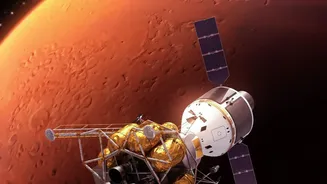
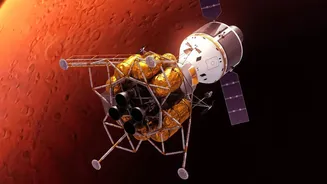
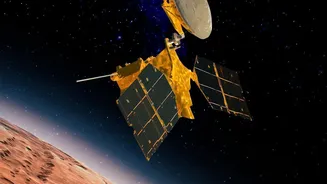
MMX’s itinerary is complex and groundbreaking. After arriving at Mars in 2027, it will enter a special 'quasi-satellite orbit' that allows it to stay close to Phobos. From there, it will spend years mapping the surface in detail to find the perfect landing spot. The mission also includes a small, 25-kilogram rover named Idefix, built by the German (DLR) and French (CNES) space agencies. Idefix will be dropped from a height of about 40 metres, bouncing on the low-gravity surface before coming to a rest. It will then explore the terrain for about 100 days, providing crucial ground-level data. The main MMX spacecraft will then perform one or two landings to collect at least 10 grams of surface material using a pneumatic sampling system. Before heading home, the craft will also conduct several flybys of the smaller, more distant moon, Deimos.
More Than Just a Rock Collection
Bringing a piece of Phobos back to Earth is about more than just settling an origin debate. Scientists believe that if the moons were captured asteroids, they could hold clues about the delivery of water and organic materials to the inner rocky planets, including early Earth. If they were formed from a giant impact, the sample would contain ancient Martian rock, offering a window into the planet's distant past without the immense challenge of landing on and launching from Mars itself. In either scenario, the samples will provide invaluable information about how planetary systems form and evolve. This is why NASA has called the science from MMX 'paradigm-shifting'. The sample return capsule is scheduled to land in Australia in 2031, where it will be recovered and the precious contents taken for study.
A Truly Global Effort
While JAXA is leading the mission, MMX is a significant international collaboration. NASA has provided a key scientific instrument, a gamma-ray and neutron spectrometer called MEGANE, to help determine the chemical composition of the moons. The French and German space agencies, CNES and DLR, jointly developed the Idefix rover. The European Space Agency (ESA) is also providing vital support, including communications through its deep space network. This global partnership builds on the success of previous Japanese sample-return missions like Hayabusa2 and highlights a shared commitment to unlocking the secrets of our solar system.