


A Cosmic Crime Scene
For years, astronomers have been puzzled by some of the Milky Way’s strange features. Our galaxy is surrounded by a vast, spherical cloud of ancient stars called the stellar halo. Observations from the European Space Agency's Gaia mission revealed something
peculiar: the stars in this halo rotate very slowly, crawling at about 25 kilometres per second. In contrast, stars in the main disk, like our own Sun, zip around the galactic centre at a brisk 220 kilometres per second. This huge discrepancy in speed didn't make sense. It pointed to a dramatic event in our galaxy's history, a puzzle that scientists at institutions like Durham University were determined to solve using powerful supercomputer simulations. They began to suspect that the slow-moving halo was the ghostly remnant of a long-dead intruder.
The Prime Suspect: A Sausage-Shaped Galaxy
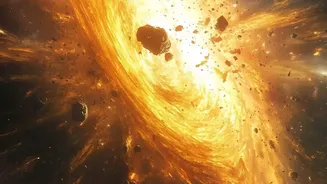
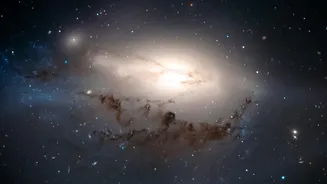
The culprit has a memorable name: Gaia-Sausage-Enceladus (GSE). This was a dwarf galaxy, but a massive one, with a total mass more than 10 billion times that of our Sun. About 10 to 11 billion years ago, long before Earth was formed, GSE smashed head-on into our young Milky Way. The evidence for this collision first came to light in 2018. Data from the Gaia satellite, which meticulously tracks the positions and movements of billions of stars, showed a distinct group of stars moving in extremely elongated, needle-like orbits. When plotted, their velocities created a shape that researchers described as a sausage, leading to the unusual name. These 'Sausage stars' were the smoking gun, the scattered debris from a galaxy that was torn to shreds in a cosmic cataclysm.
Recreating the Collision
To confirm the link between the slow halo and the ancient merger, astronomers turned to sophisticated computer models. They simulated the evolution of galaxies like our own over billions of years. The simulations showed that when a Milky Way-like galaxy suffered a massive, head-on collision with something the size of GSE, two things consistently happened. First, it produced a slow-rotating stellar halo made from the shredded remnants of the intruder galaxy. Second, and more dramatically, the immense gravitational chaos of the impact could cause the entire disk of the main galaxy to slowly but surely flip over, reorienting itself by more than 90 degrees. This 'disk flip' would have taken hundreds of millions of years, a slow-motion gymnastic feat on a galactic scale that explains the orientation we see today.
A Galaxy Forged by Violence
The collision with Gaia-Sausage-Enceladus wasn't just a fender bender; it was a formative event that fundamentally reshaped our home galaxy. The impact is believed to have triggered a massive burst of star formation, a 'galactic firework' that helped build up the Milky Way's central bulge and its thick disk. The debris from GSE now makes up the majority of our inner stellar halo, a constant reminder of the galaxy that once was. This violent merger helped transform the early Milky Way into the grand spiral structure we inhabit today. By studying the chemical compositions and ages of these 'Sausage' stars, scientists can piece together the star formation history of the vanquished galaxy and, in turn, better understand the evolution of our own.