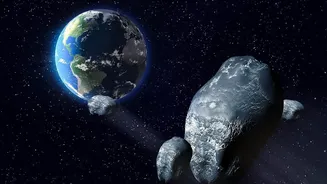







When we think of saving Earth from an asteroid, we might imagine a simple, heroic push. But new research from Sandia National Laboratories shows the reality is far more complex, revealing that where you push a lumpy asteroid matters immensely.
A More Complicated Threat
For years,
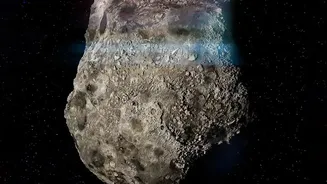
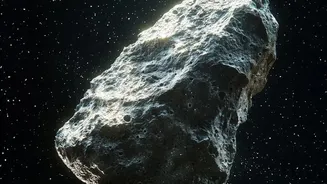
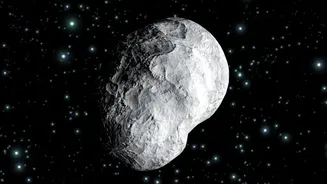
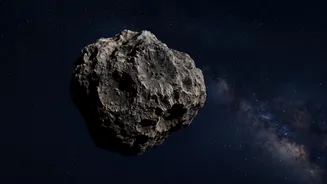
planetary defense strategies have been modeled, in many cases, on a simplified assumption: that asteroids are more or less spherical. It makes the complex physics calculations manageable. The problem, as Sandia physicist Nathan Moore puts it, is that 'spherical asteroids don't exist'. Real asteroids are lumpy, irregular objects. A groundbreaking new study from Sandia has found that this irregularity isn't just a minor detail; it's a critical factor in any plan to deflect an incoming object. The research, published in the journal Icarus, used advanced computer simulations to show that an asteroid's uneven shape can dramatically change the outcome of a deflection attempt.
Simulating the Impact
The study focused on a specific deflection method: a standoff nuclear detonation. In this scenario, a nuclear device would be exploded near an asteroid, bathing one side in powerful X-rays. This intense energy would instantly vaporize the surface material, creating a powerful jet of ejecta that pushes the asteroid, changing its trajectory. To test how an asteroid's shape affects this process, Moore and his team developed a new computer model that is over 1,600 times faster than previous algorithms. This breakthrough allowed them to combine high-resolution 3D models of real, irregular asteroids—like Bennu and Itokawa—with high-fidelity physics calculations for the first time. Previous models forced a choice between realistic shapes or detailed physics; now, researchers can have both.
The Element of Surprise
The results were startling. The simulations showed that hitting different sides of the same lumpy asteroid could produce vastly different results. In one case, the change in an asteroid's forward speed—its 'deflection velocity'—was nearly five times greater when the X-ray burst came from one direction compared to another. The effect on the asteroid's spin was even more dramatic, varying by a factor of 17 depending on the angle of the blast. 'We expected aim to matter,' Moore said in a release. 'What surprised us was how much'. This means that a poorly aimed blast might deliver a much weaker push than anticipated, while a well-aimed one could be far more effective. The findings highlight that simply hitting the target isn't enough; you have to hit the right part of the target.
The Future of Planetary Defense
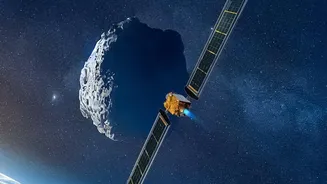
This research adds a crucial layer of sophistication to planetary defense planning. While NASA's successful DART mission in 2022 proved that a kinetic impactor—essentially a spacecraft ramming into an asteroid—can alter its orbit, the Sandia study explores a different tool for a potentially different problem, such as a last-resort scenario with short warning time. The new models allow strategists to run scenarios for specific asteroids, using their known shapes to calculate the optimal place to deliver a push. While the simulation can't yet reliably predict if an asteroid would shatter completely—a key concern, as turning one large threat into many smaller ones is not ideal—it represents a major leap forward. It transforms the problem from hitting a generic target to understanding the unique topography of a specific threat and exploiting its weaknesses. Knowing an asteroid's shape and rotation is no longer just an academic exercise; it's essential data for protecting the planet.