



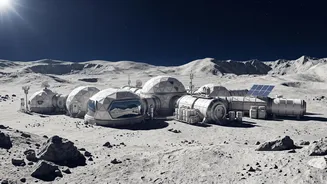
The Moon's Unforgiving Power Problem
Powering a lunar outpost isn't as simple as setting up solar panels. The Moon's south pole, a prime target for settlement due to potential water ice, is a challenging environment. It sustains a lunar night that lasts for 14 Earth days, plunging temperatures
to extreme lows and cutting off any access to solar energy. While batteries could theoretically store power, the sheer mass required to last for two weeks of darkness makes them impractical to launch from Earth. For astronauts to live, work, and conduct science sustainably, they need a continuous, reliable power source that isn't dependent on the Sun. This is why nuclear energy has emerged as the most viable solution for a permanent lunar base.
Fission Surface Power: A Mini Reactor for the Moon
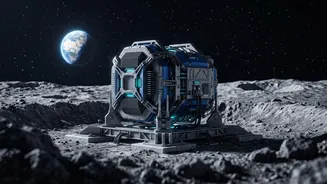
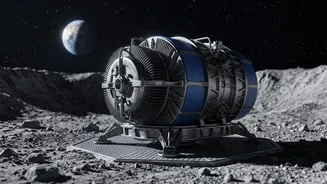
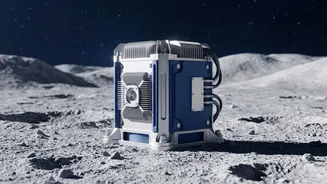
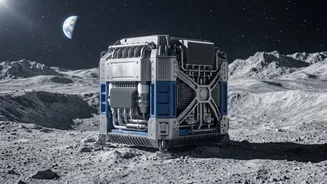
The answer being developed is a Fission Surface Power (FSP) system. In simple terms, this is a small nuclear reactor designed to be transported fully assembled from Earth. It works by splitting uranium atoms to generate heat, which is then converted into electricity. NASA and the DOE are targeting an initial demonstration system capable of producing up to 40 kilowatts of electricity—enough to power about 30 households for a decade. This would provide the consistent 'base load' power needed to run habitats, life support systems, and scientific equipment around the clock, paving the way for long-duration Artemis missions and beyond. This effort builds on decades of work, including the Kilopower project that concluded in 2018, which proved the fundamental viability of such a system.
The Immense Research Challenges
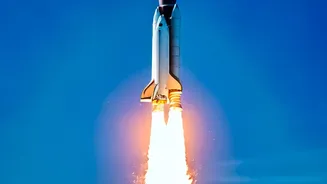
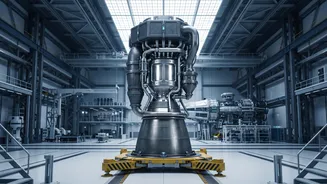
Designing a reactor for the Moon presents a unique and formidable set of engineering hurdles. The entire system must be lightweight and compact enough to fit on a rocket. Once on the surface, it must endure an environment with no atmosphere, massive temperature swings, constant cosmic radiation, and the threat of micrometeoroid impacts. One of the biggest challenges is heat dissipation. On Earth, reactors use air or water for cooling, but in the vacuum of space, this isn't possible, requiring large radiators to shed waste heat. The system must also contend with the Moon's abrasive, electrostatically charged dust, known as regolith, which can damage equipment. Finally, the reactor needs to operate almost completely autonomously for up to ten years with minimal human maintenance, a requirement unheard of for terrestrial reactors.
A Partnership Born of Necessity
Tackling these challenges requires a unique combination of expertise, which is why the partnership between NASA and the Department of Energy is so critical. For over 50 years, the DOE and its predecessors have been the world leaders in developing specialized nuclear systems for space, from the radioisotope power systems (RPSs) that have powered dozens of probes like the Voyager and Curiosity missions to early space reactor concepts. The DOE's national laboratories possess the deep knowledge of nuclear reactor design, fuel, and safety. NASA, in turn, brings its unmatched experience in space mission design, hardware integration, and operations in extreme extraterrestrial environments. This collaboration, solidified by a formal memorandum of understanding, merges NASA's space exploration needs with the DOE's nuclear capabilities, creating a focused effort to make lunar power a reality.
Powering the Next Giant Leap
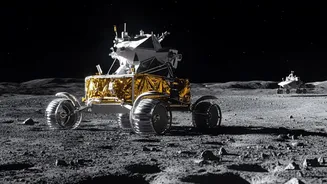
Successfully deploying a fission reactor on the Moon is more than just a technical demonstration; it's a strategic imperative. It unlocks the ability to conduct long-term science, establish permanent outposts, and test in-situ resource utilization—the idea of 'living off the land' by, for example, extracting water ice from shadowed craters. This lunar power grid would be the anchor for a future lunar economy and a critical proving ground for even more ambitious goals. The technologies and operational experience gained on the Moon will be directly applicable to future crewed missions to Mars, where the greater distance from the sun makes nuclear power even more essential. By solving the lunar power problem, the NASA-DOE partnership is laying the foundation for humanity's sustained future in deep space.