

A Galactic Detective Story
Imagine our galaxy, the familiar pinwheel of stars we call home, being knocked on its side. It sounds like science fiction, but astronomers believe this is a key chapter in our galaxy's biography. The mystery began with a puzzling observation: the stars in the Milky
Way's vast, sparse halo rotate much more slowly than those in its dense main disc. While stars in the disc (including our Sun) zip around the galactic centre at about 220 kilometres per second, halo stars crawl at a mere 25 kilometres per second. This discrepancy has long baffled scientists, suggesting a dramatic event in the galaxy's past scrambled the orbits of these ancient stars.
The Prime Suspect: A 'Sausage' Galaxy
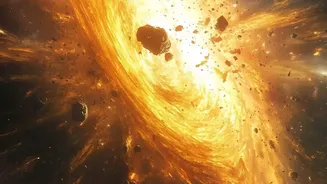
The primary clue comes from data gathered by the European Space Agency's Gaia space telescope, a mission designed to map the positions and motions of billions of stars with unprecedented accuracy. In 2018, Gaia uncovered a population of stars moving in highly unusual, elongated orbits, like needles pointing towards the galactic centre. Astronomers traced these back to a single event: a head-on collision with a dwarf galaxy roughly 10 billion years ago. This interloper, nicknamed the 'Gaia Sausage' because of the shape of its stars' orbits, was torn to shreds and consumed by the much larger Milky Way. Though classed as a 'dwarf', this galaxy was immense, containing more than 10 billion times the mass of our Sun in stars, gas, and dark matter.
Recreating the Cosmic Collision
To test the theory, researchers at Durham University ran powerful supercomputer simulations, creating virtual galaxies similar to the Milky Way. They found that galaxies experiencing a head-on collision with an object the size of the Gaia Sausage consistently exhibited two key features: a slowly rotating stellar halo and a dramatic 'disc flip'. The immense gravitational forces of the merger didn't just absorb the smaller galaxy; they exerted a powerful torque that sent the entire disc of the Milky Way tumbling. Over hundreds of millions of years, the disc gradually reoriented itself by more than 90 degrees into the position we see today. This cataclysmic event is now seen as the last major merger in our galaxy's history and a defining moment in its evolution.
A New Chapter in Our History
The discovery does more than solve a long-standing puzzle about stellar motion; it fundamentally rewrites the history of our place in the universe. It confirms that galaxies like ours grow through a process of cosmic cannibalism, by merging with and consuming smaller galaxies over billions of years. The collision with the Gaia Sausage didn't just flip the disc; it also contributed to the formation of the Milky Way's central bulge and populated its stellar halo. This implies that the very path our own Sun takes through the galaxy may have been vastly different in the distant past. We are living in the aftermath of this ancient, galaxy-shaping upheaval.