






An Ingenious Solution to Scarcity
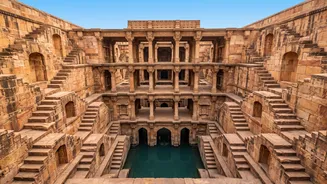
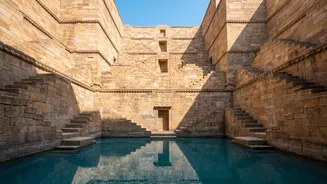
Known as 'baori' or 'vav', stepwells are architectural wonders born from necessity. Prevalent in the arid regions of western India like Gujarat and Rajasthan, they were designed to provide reliable access to groundwater year-round. These structures were excavated
deep into the earth, often several stories down, to reach the water table. Unlike a conventional well, a stepwell features a long series of steps, allowing people to descend to the water level, no matter how much it fluctuated with the seasons. During the monsoon, they would fill up to become vast reservoirs, and in the dry months, the steps ensured water was still within reach. This ingenious system of water management made them essential lifelines for communities for centuries.
A Symphony of Symmetrical Steps
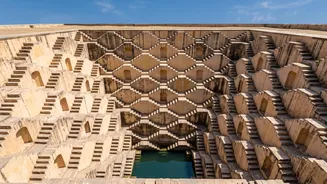
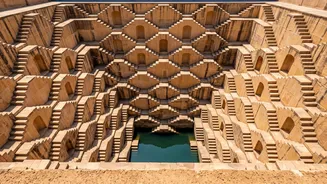
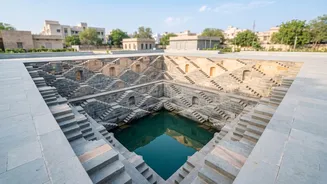
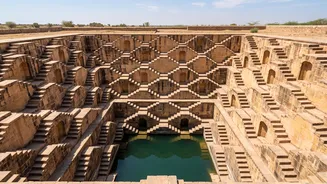
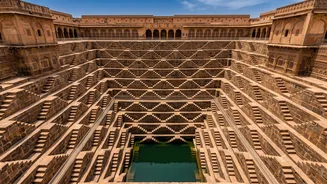
The true magic of the stepwell lies in its geometry. The design often inverts the logic of a monument; instead of rising up, it descends into the ground. At sites like Chand Baori in Rajasthan, this descent is a breathtaking spectacle. Three of its four sides are lined with 3,500 narrow, perfectly symmetrical steps arranged in a crisscrossing, diamond-like pattern. These double-flight staircases go down, meet a landing, and reverse direction, creating a hypnotic, almost fractal-like lattice. The result is a structure that appears as an upside-down pyramid, a mesmerising visual pattern that draws the eye downward. This is not just for decoration; the repetition of a single functional element—the step—scaled up thousands of time, creates a profound architectural experience. The play of light and shadow across these geometric arrangements transforms the wells into living sculptures that change throughout the day.
Form Follows Function Beautifully
The geometry of a stepwell is a perfect marriage of form and function. The vast number of steps packed into a compact area ensures continuous access to water as the level drops. The sheer depth and the mass of the surrounding earth also provided a natural cooling effect, turning the lower levels into cool, shaded sanctuaries from the intense daytime heat. Many stepwells were designed with pillared corridors, galleries, and pavilions. These spaces weren't just structural; they served as community gathering places where people, especially women, could socialise while collecting water. In this sense, the architecture directly served the social and practical needs of the community, creating a multi-functional public monument.
Masterpieces of Art and Engineering
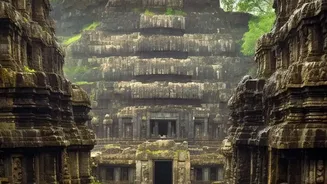
Two of the most celebrated examples showcase this geometric brilliance. Chand Baori, built around the 8th-9th century, is one of the deepest and largest stepwells in India, descending about 13 stories. Its staggering pattern of interlocking steps is a testament to the mathematical precision of its builders. In Gujarat, the 11th-century Rani ki Vav (the Queen's Stepwell) is a UNESCO World Heritage site designed as an inverted temple. It is renowned not just for its seven levels of stairs but also for its profusion of art. The walls are adorned with over 500 principal sculptures and countless minor carvings, blending religious imagery with secular scenes and intricate geometric and floral patterns. Rani ki Vav demonstrates how these structures were far more than just reservoirs; they were ornate subterranean temples celebrating the sanctity of water.
A Cultural and Spiritual Legacy
Beyond their engineering prowess, stepwells were deeply embedded in the cultural and spiritual life of India. Many featured shrines and niches with carvings of deities, turning the act of fetching water into a ritual. They were considered sacred spaces, acting as subterranean temples that hosted religious ceremonies and festivals. The descent into the earth towards the water was often seen as a symbolic journey. Today, while many have fallen into disuse with the advent of modern plumbing, there is a renewed interest in preserving these structures. They stand as a powerful reminder of an era when architecture was a holistic discipline, beautifully integrating engineering, art, community life, and spiritual devotion into a single, unforgettable form.