









A Modern Churning of the Ocean
The name 'Samudra Manthan' harks back to a pivotal story in Hindu mythology about the churning of the ocean to find hidden treasures. Today, it's the official name for India's National Offshore Exploration Scheme, a high-stakes effort to discover and
exploit hydrocarbon resources in its deep and ultra-deep waters. Approved in July 2026 with an initial outlay of ₹84,084 crore, the mission represents a strategic shift from managing energy imports to aggressively developing domestic supplies. The initiative, which will run until the 2030-31 fiscal year, was first envisioned by Prime Minister Narendra Modi during his 2025 Independence Day address as a crucial step toward national self-reliance.
The Drive for Energy Security
India is the world's third-largest consumer of crude oil, but its domestic production has been on a decline for years. The country relies on imports for nearly 90% of its oil and about half of its natural gas, making its economy highly vulnerable to global price shocks and geopolitical instability. The annual import bill for crude oil stands at around $144 billion, a massive drain on foreign exchange reserves. The Samudra Manthan mission is a direct response to this precarious situation. The goal is to significantly boost domestic production, thereby reducing import dependence and strengthening India's long-term energy resilience in a volatile global market.
Charting Unexplored Territory
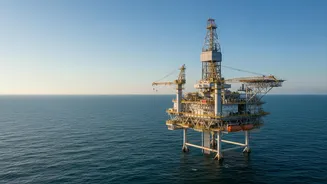
While India has a long history of onshore exploration, its vast offshore sedimentary basins remain largely untapped. These deepwater regions are believed to hold significant hydrocarbon reserves. The mission will focus on large-scale seismic surveys, data interpretation, and accelerated exploratory drilling in frontier basins like the Krishna-Godavari, Cauvery, Mahanadi, and Andaman. The government aims to add over 600 million metric tonnes of oil equivalent (MMTOE) to the country's reserves through this initiative. This involves a massive undertaking, as drilling a single well in these deepwater areas can be incredibly complex and expensive, costing between $125 million and $150 million.
De-Risking a High-Stakes Gamble
Deepwater exploration is a financially risky venture, with studies showing that as many as three out of four exploration wells fail to yield a commercial discovery. To encourage participation from both public and private sector companies, the government has structured Samudra Manthan to de-risk these initial stages. A key component of the scheme is providing financial support of up to 50% for the cost of drilling deepwater exploration wells. The mission also includes plans for developing common offshore infrastructure for production and evacuation, which would further lower the barrier to entry for operators. By shouldering a significant portion of the upfront risk, the government hopes to catalyse greater private investment in India's offshore sector.
Balancing Ambition with Reality
While the mission's goals are ambitious, experts caution that it is a long-term play. Even if successful, commercial production from new discoveries is years away. The government projects that the scheme will increase annual domestic production from about 62 MMTOE to 80 MMTOE, but this would only reduce overall import dependence by an estimated 3% to 5% given India's rapidly growing energy demand. Furthermore, a major push for fossil fuel exploration raises environmental questions, especially concerning fragile marine ecosystems. The government has stated the mission integrates technological innovation and indigenous manufacturing, aligning with its 'Atmanirbhar Bharat' (self-reliant India) vision, but the challenge will be to balance this industrial push with robust environmental safeguards.