


The Solar System's Missing Piece
When we look out into the galaxy, our solar system is a bit of an oddball. Surveys of distant stars have revealed that a very common type of planet, the “super-Earth,” seems to be everywhere. These are rocky worlds larger than Earth but smaller than Neptune,
and they are frequently found orbiting close to their parent stars. Yet, in our own cosmic backyard, there are no such planets. The space between our sun and Mercury, its closest planet, is conspicuously empty. This absence has become a major puzzle for astronomers trying to understand how planetary systems form and evolve. Why would our system be so different from the galactic norm? The answer, according to a growing body of research, might be that such a planet did exist here once, but it didn't survive.
The 'Fallen Planet' Hypothesis
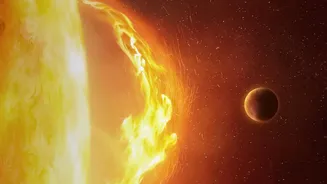
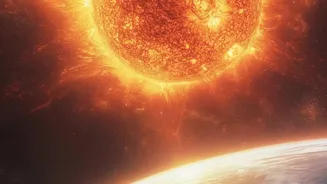
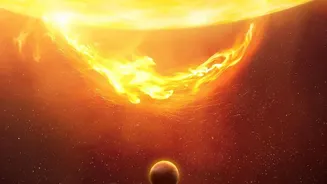
A compelling new hypothesis, detailed in a recent study published in the Monthly Notices of the Royal Astronomical Society, suggests that one or more super-Earths may have formed in the early solar system. In the chaotic environment of the young protoplanetary disk—a swirling ring of gas and dust around the newborn sun—planets don't always stay put. This process, known as planetary migration, can cause a planet's orbit to decay, sending it spiraling inward. The theory proposes that a super-Earth, perhaps five to ten times the mass of our own planet, formed and then migrated too close to the sun. Instead of settling into a stable orbit, its path decayed until it was ultimately swallowed by the star in a cataclysmic event billions of years ago.
Searching for Celestial Clues
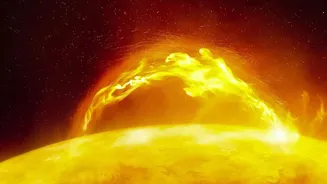
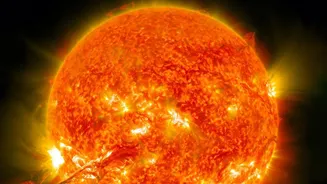
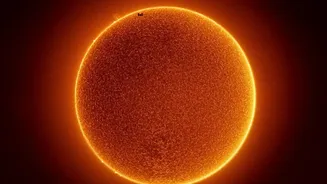
Proving that an object was destroyed billions of years ago is a monumental challenge, but scientists believe the sun itself may hold the evidence. A study led by Professor Mutlu Yildiz of Ege University in Turkey used advanced computer models to simulate what would happen if the young sun consumed a massive rocky planet. The research suggests that such an event would leave lasting “fingerprints.” The engulfed planet's heavy elements would not have simply burned up on the surface but would have penetrated deep into the star's interior, altering its chemical composition and internal structure. These changes could potentially explain several long-standing mysteries about our sun, including a lower-than-expected amount of the element lithium on its surface and subtle discrepancies in its internal structure that standard models can't account for.
How to Find a Ghost Planet
Scientists cannot directly see inside the sun, but they can study it using a technique called helioseismology, which analyses the sound waves that travel through the star and cause its surface to vibrate. These vibrations provide crucial data about the sun's internal layers, much like how geologists use seismic waves to study Earth's interior. By comparing the observed data from helioseismology with their models, scientists can test different scenarios. The models incorporating a planetary engulfment event appear to provide a better match for the sun's currently observed structure and chemistry. While this isn't definitive proof, it provides a testable prediction. If the chemical and structural imprints predicted by the models are confirmed by future, more precise observations, it would be powerful evidence for this lost world.
A Violent Past, A Stable Present
The idea of a planet being consumed by its star might sound like science fiction, but astronomers have observed evidence of this happening around other stars. The chaotic dance of planetary migration in a young system makes such events plausible. If a super-Earth did once orbit close to our sun, its dramatic demise could have had a profound impact on the formation of the other inner planets. Its gravitational influence and eventual removal may have cleared out material from the inner solar system, shaping the final orbits of Mercury, Venus, Earth, and Mars. This violent act could, paradoxically, be one of the reasons our solar system is the way it is today—a relatively stable and orderly place that allowed life to flourish on at least one of its worlds.