





A Tale of Two Shields
Every planet with a magnetic field has a magnetosphere, a protective bubble that deflects the harsh solar wind streaming from the sun. Earth’s is a relatively tidy affair, generated by its molten iron core. This field is tilted about 11 degrees from our
planet's rotational axis, creating a stable, predictable shield. This tilt is crucial, as it’s believed that a perfectly aligned field would be unstable and unable to sustain itself according to dynamo theory. Our magnetosphere protects our atmosphere and allows life to thrive, creating phenomena like the aurora borealis when solar particles do sneak through. For decades, scientists used Earth as the primary model for how these planetary shields should work. Saturn, however, had other ideas.
The Puzzles of Saturn
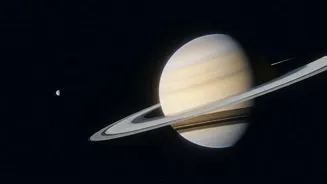
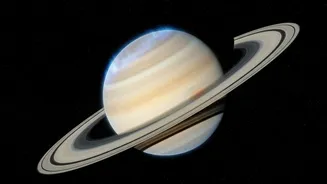
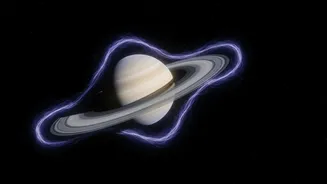
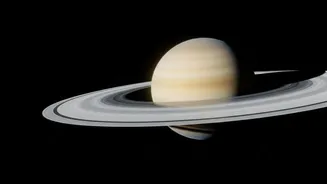
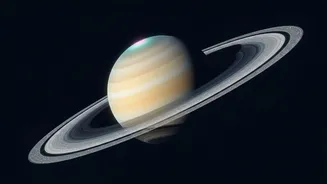
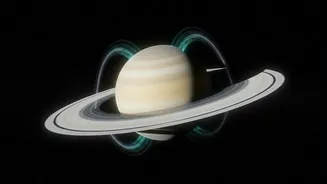
When spacecraft like Pioneer 11 and the Voyagers first flew by Saturn, they found a magnetic field that was bizarrely unique. Unlike Earth, Jupiter, or any other planet with a global magnetic field, Saturn’s is almost perfectly aligned with its axis of rotation—the tilt is less than one degree. This directly contradicts the established theories of how planetary dynamos work and has been a long-standing puzzle for planetary scientists. The Cassini mission, which orbited Saturn from 2004 to 2017, gathered an unprecedented amount of data, allowing for a much deeper look into this strange system. Even years after the mission's end, scientists are still sifting through this treasure trove to understand what makes the ringed planet's shield so different.
A Shield Shaped from Within
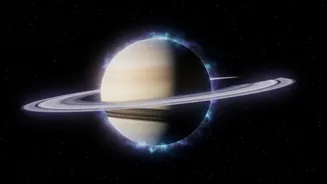
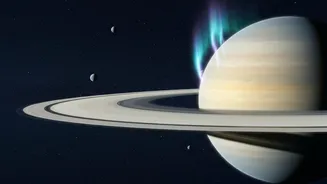
Recent analysis of Cassini data published in 2026 has provided a major breakthrough. The new findings confirm that Saturn's magnetosphere isn't primarily shaped by the solar wind, as Earth's is. Instead, its structure is dominated by the planet’s rapid rotation (a day is just 10.7 hours) and a massive cloud of plasma spewing from its moons. The main contributor is the icy moon Enceladus, which blasts plumes of water vapor into space from its subsurface ocean. This material becomes ionized (electrically charged) and is then grabbed by Saturn's magnetic field, creating a thick, heavy soup of plasma that the planet drags around as it spins. This internal mass-loading of the system is so significant that it overpowers the influence of the sun.
A Lopsided Bubble
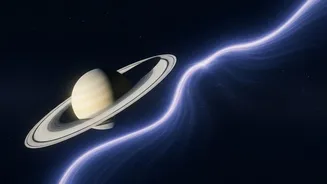
This internal engine has a dramatic effect on the magnetosphere's shape. On Earth, the 'cusp'—a funnel-like opening near the pole where solar wind particles can enter—is located neatly at the 'noon' position, directly facing the sun. However, the new analysis of Cassini data shows Saturn's cusp is consistently dragged far to the side, into the afternoon sector (between 1:00 and 3:00 on a clock face). This skew confirms that Saturn's rapid spin and the plasma from Enceladus are the dominant forces sculpting the magnetic environment. The result is a lopsided, asymmetrical bubble, fundamentally different from Earth's more balanced shield. This discovery changes how scientists understand magnetic reconnection, the process that triggers auroras and accelerates particles to high energies.
Why the Difference Matters
Understanding Saturn’s unique system is about more than just one planet. It provides a crucial counterpoint to Earth, demonstrating a different way a magnetosphere can operate. This is vital for scientists studying distant exoplanets. Many of the gas giants discovered orbiting other stars are also likely to be fast rotators, and some may have active moons. Saturn provides a local laboratory for a type of magnetic system that might be common throughout the galaxy. The ongoing analysis of Cassini's incredible dataset not only solves long-standing mysteries about our own solar system but also gives us the tools to better interpret the alien worlds we are only just beginning to discover. It shows that when it comes to planetary protection, there is more than one way to build a shield.