




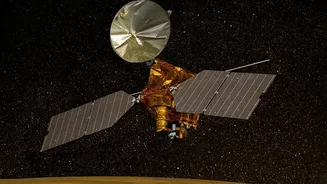


A New Vantage Point for India
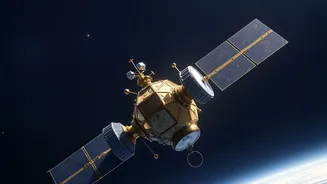
The EOS-05 mission is fundamentally different from most of India's previous Earth observation satellites. While platforms like the Cartosat and RISAT series operate in Low Earth Orbit (LEO), just a few hundred kilometres up, EOS-05 has been placed in a geosynchronous
orbit roughly 36,000 kilometres away. This high-altitude position is a game-changer. Instead of passing over a location for only a few minutes at a time, EOS-05's orbit allows it to 'hover' over the Indian subcontinent. This enables it to provide near-continuous monitoring of the same broad geographical area, a capability India has been seeking for years. The satellite can capture images of the entire country in about 30 minutes and revisit specific areas of interest every five minutes, representing a shift from periodic observation to persistent surveillance.
Guardian, Forecaster, and Farmer's Friend
This ability to watch events unfold in near-real-time has profound implications. For national security, it provides an invaluable tool for border surveillance and monitoring strategic assets. In disaster management, its impact will be immediate and life-saving. The satellite can track the development of cyclones, floods, and forest fires as they happen, giving authorities a crucial edge in planning evacuations and response efforts. This persistent watchfulness also extends to weather monitoring and agriculture, allowing for better tracking of rapidly evolving weather systems and providing frequent data for crop assessment. With its advanced multi-spectral and hyperspectral imaging capabilities, EOS-05 is designed to serve both civilian and strategic applications, making it one of ISRO's most versatile assets in orbit.
A Story of Resilience and Redemption
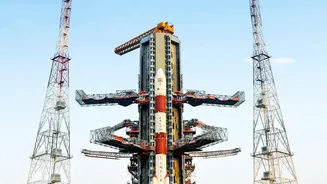
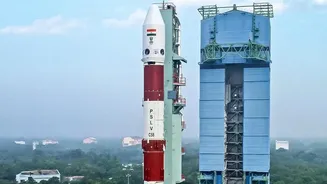
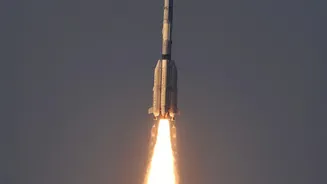
The success of EOS-05 is made even more significant by the challenges that preceded it. The mission serves as a direct replacement for EOS-03, a similar satellite that was lost during a GSLV launch failure in August 2021 due to an anomaly in its cryogenic upper stage. Overcoming that technical hurdle and delivering EOS-05 to its intended orbit is a major victory for the GSLV programme, boosting confidence in the indigenous cryogenic engine technology. Furthermore, the launch came after a difficult period for ISRO, which saw two uncharacteristic failures of its workhorse PSLV rocket in 2025 and 2026, leading to a launch hiatus of nearly seven months. The successful flight of GSLV-F17 carrying EOS-05 is therefore a powerful demonstration of the space agency's ability to diagnose problems, overcome setbacks, and bounce back.
The Strategic Imperative
Beyond its scientific and civilian uses, the EOS-05 represents a significant leap in India's strategic capabilities. Having a sovereign, high-altitude imaging platform reduces reliance on foreign sources for critical intelligence and environmental data. This enhances India's strategic autonomy in monitoring its neighbourhood and protecting its interests. The mission is a clear signal of India's ambition to develop an integrated space ecosystem, where advanced satellites provide crucial data for everything from economic planning and resource management to national security. By establishing this persistent surveillance capability, India joins a select group of nations able to monitor vast territories from a fixed point in the sky, solidifying its position as a major space power.