








A New Space Race Over India
The skies above India are becoming a crowded and competitive marketplace. Elon Musk’s Starlink, the Bharti-backed Eutelsat OneWeb, and Amazon's Project Kuiper are all vying for a piece of the country's satellite communication (satcom) market. They are not
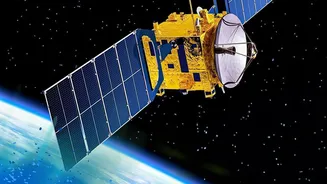
alone. Reliance Jio is also making an ambitious entry, planning its own constellation of 1,600 low-earth orbit (LEO) satellites with a test flight targeted for 2027. This convergence of global and domestic giants signals a pivotal moment. While companies like Eutelsat OneWeb have held licenses for years, recent policy movements have accelerated the race, turning long-held plans into an imminent reality. The new LEO satellite technology is a game-changer, promising lower latency and higher speeds than older geostationary satellites, making it a viable alternative to terrestrial broadband for the first time.
The Final Frontier for Connectivity
The primary promise of satellite broadband is simple: to connect the unconnected. Despite having over a billion internet subscribers as of March 2026, a significant digital divide persists. Rural internet penetration stands at just 48 subscriptions per 100 people, compared to 127 in urban areas. Millions of people in mountainous regions, forests, and remote villages remain outside the reach of fibre optics and reliable mobile towers, where the cost of deploying terrestrial infrastructure is prohibitively high. Satellite technology bypasses these geographical and economic barriers entirely, beaming internet directly to a user terminal. As TRAI Chairman A.K. Lahoti noted, satcom will play a crucial complementary role to existing networks by delivering services to these difficult-to-reach areas, supporting everything from digital education to telemedicine.
Navigating the Regulatory Maze
For years, the biggest bottleneck for satellite broadband in India wasn't technology but regulation. Companies holding the necessary licenses found themselves waiting for final clearances on spectrum allocation and national security. However, the landscape shifted in September 2026 when the Digital Communications Commission (DCC) approved many of TRAI's key recommendations. This has cleared the path for the administrative assignment of spectrum for five-year terms. Companies will have to pay a Spectrum Usage Charge (SUC) equivalent to 5% of their adjusted gross revenue, with a discounted rate of 4% for services provided in designated remote areas to incentivize rural deployment. While final cabinet approval and company-specific security clearances are still pending, this decision removes a major hurdle that had delayed commercial launches for years.
Beyond Homes: Enterprise and Government
While connecting individual households is a key goal, much of the immediate business case for satellite internet lies with enterprise and government applications. Industry experts anticipate strong demand from sectors that operate in remote locations. This includes providing reliable connectivity for banking services, ATMs, military operations, disaster management, and industrial sites where terrestrial networks are either unavailable or unreliable. For instance, Eutelsat OneWeb has already begun providing services to Indian defense personnel under a provisional license, highlighting the strategic importance of this technology. Satellite links can provide critical backhaul for remote mobile towers, extending the reach of 4G and 5G networks, and ensuring business continuity during natural disasters when ground infrastructure is damaged.
The Challenge of Price and Security
Two significant questions remain: affordability and security. The one-time cost for user terminals, or dishes, can range from ₹20,000 to ₹50,000, a steep price for many rural households. While TRAI had proposed subsidizing these terminals, the idea was not accepted by the Department of Telecommunications. Monthly subscription costs are also expected to be higher than fibre or mobile data plans, shifting the digital divide from an issue of access to one of affordability. Furthermore, security agencies have expressed caution, seeking assurance that they can control and monitor data flowing through foreign-owned satellite networks during a crisis. These final security clearances, along with Foreign Direct Investment (FDI) approvals for players like Starlink and Amazon, are the last gates before services can be commercially rolled out to the public.