



An Invisible Forcefield
A magnetic field, or magnetosphere, is an invisible bubble of energy that surrounds a celestial body. Earth has a powerful one, generated by the churning of its molten iron core. This shield is crucial for life as we know it, deflecting harmful solar
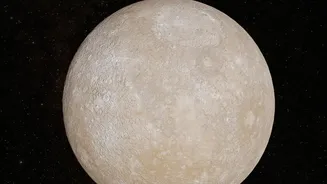
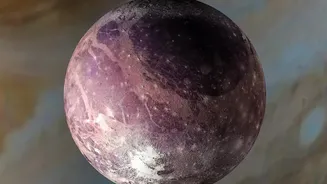
wind and cosmic radiation that would otherwise strip away our atmosphere. Without it, Earth’s surface would be far more exposed to dangerous particles from the sun. While several planets like Mercury, Jupiter, and Saturn have these fields, Ganymede is the only moon in the entire solar system known to generate its own.
The Engine Within
So, how does a moon create a feature usually reserved for planets? The answer lies deep inside. Like Earth, Ganymede is believed to have a liquid, iron-rich core. The combination of this churning, electrically conductive liquid metal and the moon's rotation creates a dynamo effect, generating a magnetic field. The discovery, made by NASA's Galileo spacecraft in 1996, was a surprise to scientists. They had expected Ganymede's core to have cooled and solidified long ago, which would have shut down any magnetic activity. The prevailing theory is that gravitational tugs from Jupiter keep its core partially molten through tidal heating, providing the necessary energy to power the dynamo.
A Magnetosphere Within a Magnetosphere
Ganymede's situation is even more remarkable because it orbits within Jupiter's own magnetosphere, which is the largest and most powerful in the solar system, about 20,000 times stronger than Earth's. Ganymede's personal magnetic shield is strong enough to carve out its own distinct bubble within this larger field, creating a rare magnetosphere-within-a-magnetosphere. This complex interaction creates spectacular phenomena. As charged particles from Jupiter's environment are funnelled towards Ganymede's poles, they cause aurorae—glowing ribbons of light similar to Earth's Northern and Southern Lights. The way these aurorae rock back and forth helps scientists study not only the magnetic fields but also the properties of the vast saltwater ocean believed to exist beneath Ganymede's icy crust.
Why Other Moons Fall Short
The reason other moons lack this feature often comes down to size and internal heat. Most moons are too small to have retained enough heat from their formation to keep a metallic core liquid. Over billions of years, their cores have cooled and solidified, shutting down any potential dynamo. Earth's own Moon, for example, may have had a weak magnetic field in its distant past, but its core solidified long ago. Some other moons, like Europa, do have induced magnetic fields, which are temporarily created by the powerful pull of Jupiter's field, but these are not self-generated. Ganymede is just the right size and in the right orbital position to have maintained the internal heat necessary for this planetary-style feature.
Unlocking Deeper Secrets
Ganymede's unique magnetic field offers more than just a celestial curiosity. It provides a natural laboratory for understanding how planetary bodies form and evolve. The presence of the field has also protected parts of Ganymede's surface, allowing scientists using NASA's Juno spacecraft to find evidence of salts and organic compounds. These materials may be remnants from the deep ocean brine reaching the surface, offering clues about the moon's composition and potential for past or present habitability. Missions like the European Space Agency's JUICE (Jupiter Icy Moons Explorer) are specifically designed to study Ganymede in greater detail, promising to uncover more secrets about this extraordinary world.