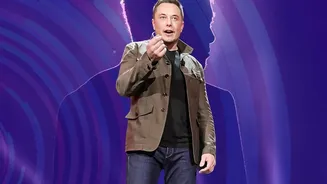







Elon Musk, a man known for launching rockets and reimagining electric cars, has turned his attention to a more terrestrial target: English grammar. He has a new idea for punctuation—specifically for parenthetical phrases—that he believes would improve
clarity.
The Problem With Dashes
The proposal, floated on the social media platform X, is Musk’s solution to a problem he sees with the em dash—the long dash used to set off an aside or an amplifying thought. In a recent post, Musk argued that the current rules for em dashes are confusing. 'The rules of English need to change to put spaces between the em dashes, as they presently too much resemble a hyphenated word, rather than a parenthetical phrase,' he wrote. According to most style guides, the em dash (—) is used without spaces on either side. Musk’s critique is that this makes it visually similar to a hyphen, potentially causing a reader to stumble. He also finds the em dash 'unpleasantly long' and suggests the shorter en dash (–) would be a 'better length,' but with spaces around it to clearly set it apart from the main sentence. So, instead of writing 'The answer—if you can believe it—is 42', Musk’s preferred style would be 'The answer – if you can believe it – is 42'.
What is a Parenthetical Phrase?
Before diving deeper, it’s helpful to understand what a parenthetical phrase is. In grammar, it's a word or group of words inserted into a sentence that provides extra information but isn't essential to the sentence's core meaning. You can remove the parenthetical, and the sentence will still be grammatically complete. These asides are typically set off by commas, round brackets (which are also called parentheses), or, as Musk noted, em dashes. For example, in the sentence, 'My neighbour, a retired firefighter, often helps with my gardening', the phrase 'a retired firefighter' is a parenthetical. It adds interesting context but isn’t required for the sentence to make sense. Musk's focus is purely on the visual execution of these phrases when dashes are used.
A History of New Punctuation
Musk is hardly the first person to suggest an update to our system of dots and squiggles. The history of punctuation is a long story of evolution and failed experiments. For centuries, writing in the classical world had no punctuation or even spaces between words. The first systems were developed by Greek scholars to help actors know when to pause during performances. The invention of the printing press in the 15th century was a major catalyst for standardization, as printers like Aldus Manutius in Venice sought a consistent set of marks for their books, giving us the comma and semicolon in forms we recognize today. But many proposed marks have failed to catch on. In 1962, advertising executive Martin K. Speckter invented the 'interrobang' (‽) to combine a question mark and an exclamation point for surprised questions. Despite appearing on some typewriters, it fell into obscurity. Similarly, French author Hervé Bazin proposed a series of 'tone indicators' in 1966, including marks for irony, doubt, and love, but none were adopted. Language is notoriously resistant to top-down change.
Will Musk's Idea Stick?
The chance of Musk's suggestion being formally adopted by style guides like the Associated Press Stylebook or The Chicago Manual of Style is slim. These institutions are built on tradition and consistency, and changes are made slowly and with broad consensus. While some publications already opt for a spaced en dash instead of a closed em dash as a house style, it's not a universal rule. Musk's influence is immense in technology and business, but making a dent in the English language is a different challenge entirely. He has tried to change language before, insisting people call 'tweets' 'X’s', a move that has seen limited organic uptake. However, the digital age has accelerated linguistic change in other ways. The informal nature of texting and social media has led to the rise of emojis and other creative uses of existing punctuation to convey tone. In this sense, Musk's post is less a formal proposal and more a reflection of how digital platforms make everyone a potential language critic and innovator.