


The Cosmic Challenge
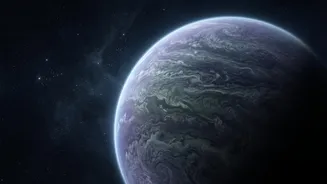
Studying planets outside our solar system, known as exoplanets, is incredibly difficult. They are unimaginably distant, and we can't visit them. Instead, scientists act as cosmic detectives, analysing the faint light that travels from a planet's host
star and passes through its atmosphere. By looking at which colours of light are absorbed, they can deduce which chemicals are present, a technique called spectroscopy. This method has been used to identify gases like water and methane on distant worlds. However, simply finding a gas linked to life on Earth isn't enough proof, as non-biological processes can also create them.
What is Solar Chemistry?
This is where solar chemistry, or photochemistry, comes in. It refers to the chemical reactions driven by a star’s energetic light. Think of it like sunlight causing a photograph to fade or giving you a sunburn; starlight has the power to break apart and reassemble molecules in a planet's atmosphere. NASA's James Webb Space Telescope (JWST) has already found concrete evidence of this process on an exoplanet named WASP-39 b. The presence of sulfur dioxide in its atmosphere could only be explained by the star's light triggering chemical reactions. This confirmed that a star doesn't just provide warmth; it actively shapes its planet's atmosphere.
A Planet's Unique Fingerprint
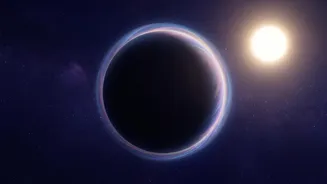
The new research proposes that this photochemical process creates a distinct “fingerprint.” This isn't a literal print, but a specific combination and pattern of atmospheric gases that is unique to the interaction between that planet and its particular star. For example, a planet orbiting a cool, dim M-dwarf star will be bathed in a different quality of ultraviolet light than a planet orbiting a star like our sun. According to scientific models, this difference in light dramatically changes how atmospheric gases like oxygen, ozone, and methane are produced and destroyed. On Earth, our ozone layer is primarily formed through one set of reactions, but on a planet orbiting a cool M-dwarf, ozone might be created through smog-like chemical pathways instead.
What the Evidence Shows
Much of the evidence for this phenomenon comes from sophisticated computer models that simulate the atmospheric conditions on Earth-like planets orbiting different types of stars. These models, which combine climate and photochemical data, predict what chemical signatures future telescopes might see. Researchers found that the type of host star is a dominant factor. For instance, gases considered potential biosignatures, like nitrous oxide, are more likely to build up in the atmospheres of planets around cooler stars because the lower UV radiation doesn't destroy them as quickly. These simulations allow scientists to predict which chemical patterns point to a specific stellar environment, helping them distinguish between a dead world and a potentially living one.
Refining the Search for Life
This concept moves the search for life beyond hunting for a single “biosignature” gas. Instead of just looking for oxygen, scientists can now search for a holistic chemical pattern. This approach helps to avoid false positives, where a gas like oxygen or methane is created by geological or chemical processes, not life. For example, lightning can produce gases that might mimic biosignatures or even mask the presence of an ozone layer, confusing observers. By understanding the expected photochemical fingerprint of a planet based on its star, scientists can better determine if the observed chemicals are a result of natural, non-living solar chemistry or if something else—like biology—is tipping the scales.