


A Global Hub for Space Operations
SMOPS-2026, the International Conference on Spacecraft Mission Operations, recently convened in Bangalore, India, bringing together global space agencies, industry leaders, and academics. Hosted by the Indian Space Research Organisation (ISRO) and its
partners, the conference focused on innovative and sustainable management of space missions. A central theme was the growing complexity of space, with increasing traffic, large satellite constellations, and ambitious new missions pushing legacy systems to their limits. Against this backdrop, AI and machine learning were presented not as theoretical concepts, but as essential tools for the future of spaceflight.
The Problem with Crowded Skies
Imagine being an air traffic controller, but the 'planes' are moving at over 28,000 kilometres per hour and the 'sky' is filled with millions of pieces of debris. This is the reality of modern space operations. Every active satellite, from tiny CubeSats to the International Space Station, requires constant monitoring. Human operators must make countless routine decisions: minor course corrections to avoid collisions, adjustments to maintain optimal orbital position (a process called 'station-keeping'), and scheduling communications links. As commercial companies launch vast constellations of thousands of satellites, this manual approach is quickly becoming untenable. The sheer volume of data and the speed at which threats can emerge demand a faster, more autonomous solution.
AI Takes the Helm for Routine Tasks
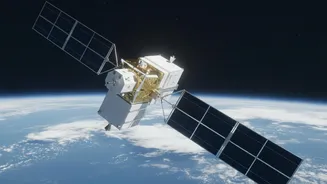
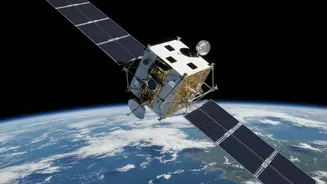
This is where the evidence presented at SMOPS-2026 becomes compelling. The discussion is shifting from theory to practice, with agencies demonstrating real-world applications of AI in orbit. For instance, the US Air Force Research Laboratory recently proved a neural network could autonomously control a satellite's attitude and core functions. Instead of a human on the ground meticulously planning every maneuver, the AI processes sensor data in real-time to make its own adjustments. These are not yet dramatic, mission-altering choices. Rather, they are the countless 'housekeeping' tasks: optimizing power usage, managing thermal systems, and, most importantly, executing tiny thruster burns to maintain a precise path. By automating these duties, AI frees up human experts to focus on more complex, strategic challenges.
From 'Human-in-the-Loop' to 'Human-on-the-Loop'
The operational philosophy is changing from 'human-in-the-loop', where a person must approve every action, to 'human-on-the-loop', where humans supervise and manage the AI agents doing the work. This human-machine synergy was a key point of emphasis at SMOPS. Companies like Slingshot Aerospace are developing AI training agents, such as TALOS, for the U.S. Space Force. These virtual opponents simulate threats and unpredictable maneuvers in training exercises, allowing operators to build trust in and understand the capabilities of their autonomous systems. This evidence-based trust is crucial, as operators need assurance that AI-driven decisions are reliable and auditable.
The Next Frontier: Distributed Intelligence
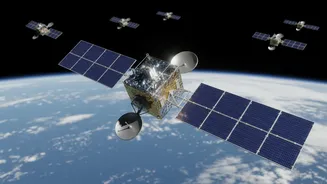
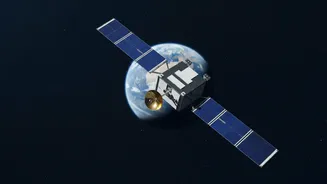
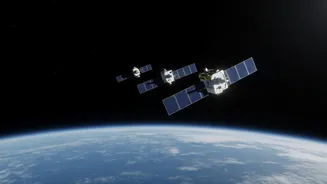
The success of AI in handling routine decisions is just the beginning. The long-term vision is to create distributed intelligence networks in space. Future satellite constellations could act as a coordinated, thinking system. If one satellite detects an anomaly or a potential threat, it could autonomously share information and coordinate a response with its neighbors, all without waiting for commands from Earth. This capability is critical for building a resilient space infrastructure, one that can adapt to challenges—from space debris to adversarial actions—with minimal human intervention. The evidence from SMOPS-2026 and related military exercises indicates that the foundational blocks for this autonomous future are being laid today.