




From Ski Slopes to Sidewalks
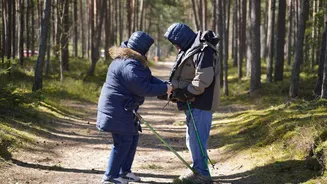
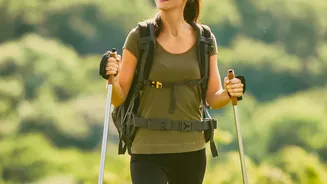
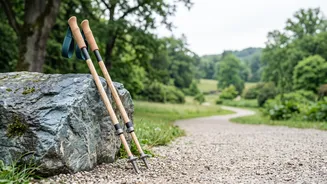
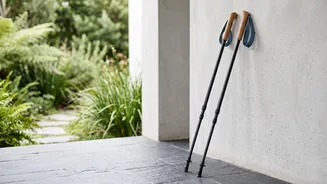
Nordic walking originated in Finland as a way for cross-country skiers to train during the summer months. The technique mimics the powerful arm and leg motion of skiing but adapts it for dry land. Unlike trekking poles, which are primarily used for stability
on uneven terrain, Nordic walking poles are specifically designed to help propel you forward. This propulsive action is the secret to its effectiveness. By applying force to the poles with each stride, you transform walking from a lower-body exercise into a comprehensive workout that involves muscles from your shoulders down to your feet.
Engaging the Upper Body, Step by Step
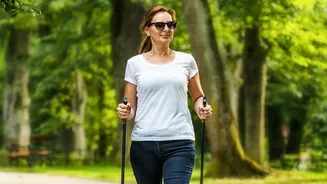
When you walk normally, your arms swing passively. In Nordic walking, they become active participants. The basic movement involves coordinating your opposite arm and leg: as your left leg steps forward, your right arm swings forward to plant its pole. As you move past the planted pole, you push off, engaging the muscles in your arm, shoulder, chest, and back. This push-off motion specifically targets the triceps, latissimus dorsi (lats), and pectoral muscles—areas that get almost no love during a standard walk. Studies have shown that this technique can increase upper body muscle activation by two to fifteen times compared to conventional walking.
A True Full-Body Workout
The benefits don't stop with your arms and shoulders. While regular walking primarily engages about 50% of your body's muscles, Nordic walking brings that number up to an impressive 80-90%. The act of pushing off the poles requires you to engage your core muscles for stability and to maintain an upright posture. This constant core activation helps strengthen your abdomen and lower back. By turning your walk into a coordinated effort between your upper and lower body, you create a more holistic and efficient form of exercise.
The Calorie-Burning Advantage
Engaging more muscles requires more energy, which translates to a higher calorie burn. Research consistently shows that Nordic walking burns significantly more calories than regular walking at the same pace. Estimates vary, but studies suggest an increase of anywhere from 18% to over 60%, with a common finding around a 20% increase. What's particularly interesting is the "perceived exertion gap." Many people report that while they are burning more calories and their heart rate is higher, the workout doesn't feel substantially harder than a brisk walk. This makes it an excellent option for those looking to increase the intensity of their exercise without the high impact of jogging.
Improved Posture and Reduced Joint Stress
Modern lifestyles often lead to slouching, but Nordic walking encourages a more upright posture. Keeping your shoulders back and chest lifted is part of the correct technique, helping to counteract the effects of sitting at a desk. The poles also provide additional support and stability, which can be a major benefit for older adults or those with balance concerns. Furthermore, the poles help distribute your body weight and absorb some of the impact with each step, reducing stress on your knees, hips, and lower back. This makes it a joint-friendly, low-impact exercise suitable for a wide range of fitness levels and ages.
How to Get Started
While it might look as simple as walking with sticks, proper technique is key to unlocking the full benefits. Start by standing tall with your shoulders relaxed. The arm swing should come from the shoulder, not the elbow, in a natural, fluid motion. Plant the pole at an angle behind you, rather than straight down, to create propulsion. As one arm swings forward, relax and open your hand on the opposite arm during its backswing. It can take a few tries to find a rhythm, but focusing on this coordinated opposition of arms and legs will quickly make the movement feel natural.