




A Pioneer's Enduring Legacy
Before diving into the hardware, it is essential to understand the name behind the mission. The telescope is named after Dr. Nancy Grace Roman, a trailblazing astronomer who became NASA's first chief of astronomy and the agency's first female executive.
Often called the “Mother of the Hubble Space Telescope,” Roman was instrumental in convincing NASA and the U.S. Congress to build and launch the iconic observatory. She championed the idea of space-based astronomy, arguing that getting above Earth's atmosphere was crucial for a clearer view of the universe. Naming this next-generation observatory after her is a fitting tribute to a scientist who broke barriers and fundamentally shaped modern astrophysics. Her work paved the way not just for Hubble, but for a whole fleet of cosmic explorers.
The Mirror's Wide-Angle Magic
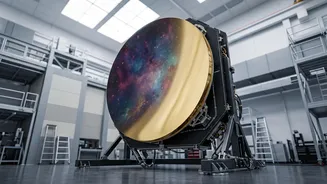
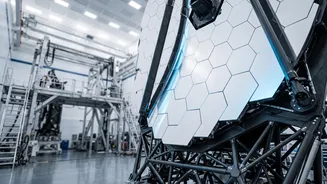
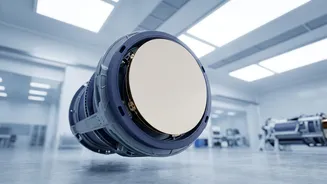
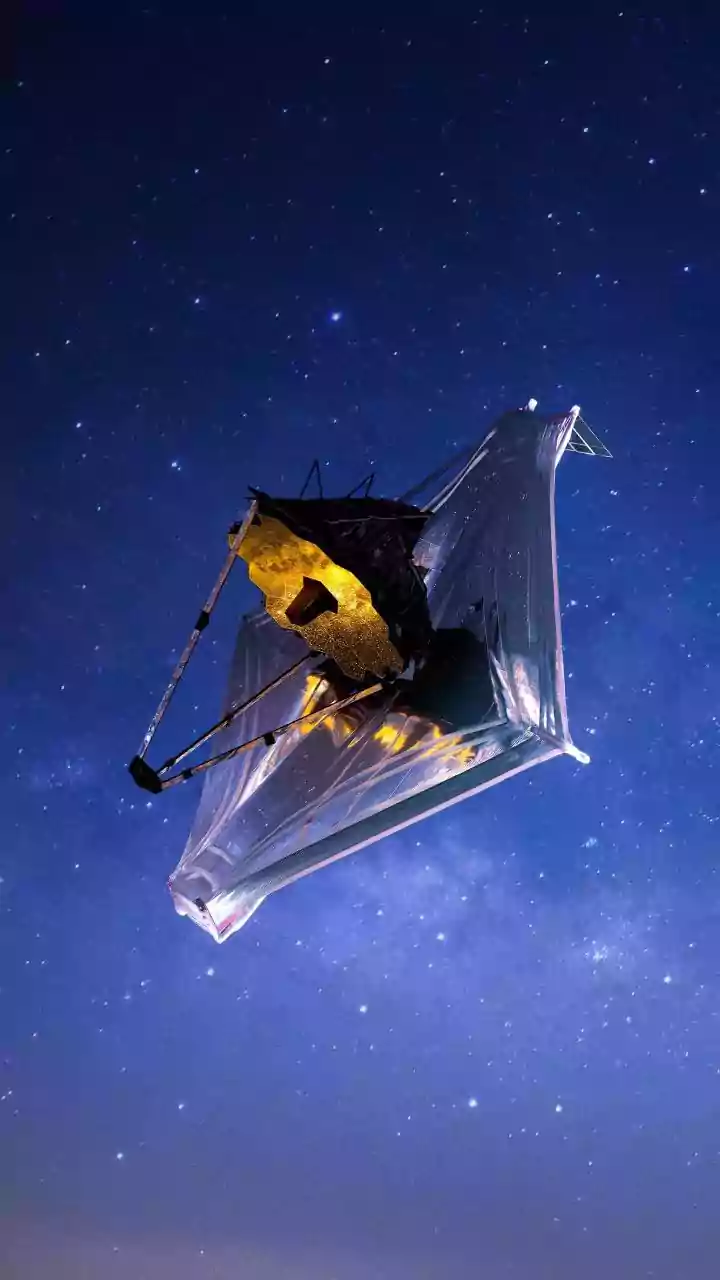
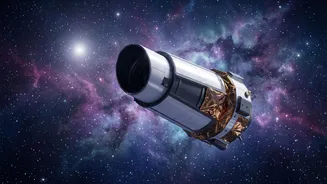
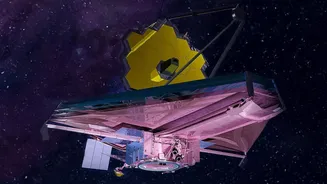
At the heart of the Roman telescope is its primary mirror, which measures 2.4 meters (7.9 feet) in diameter—exactly the same size as the mirror on the Hubble Space Telescope. But this is where the similarities end. Thanks to a different optical design, Roman's mirror allows its main instrument to see a patch of sky 100 times larger than Hubble can in a single snapshot. Think of Hubble and the James Webb Space Telescope (JWST) as zoom lenses, perfect for getting stunning, detailed close-ups of individual galaxies or nebulae. Roman, in contrast, is a wide-angle lens, designed to create vast, panoramic images of the cosmos with the same sharp resolution as Hubble. This ability to rapidly survey huge sections of the sky is what makes Roman a game-changer for astronomy. In its five-year primary mission, it is expected to map an area 50 times larger than Hubble has in over 30 years of operation.
A Powerful Cosmic Partnership
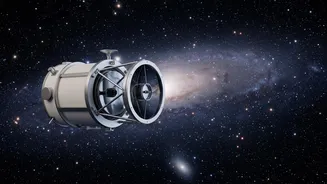
Roman is not a replacement for Hubble or Webb, but a powerful new partner in our exploration of the universe. The three telescopes are designed to work together, each playing to its strengths. While Roman scans the sky to build enormous cosmic maps, it will identify countless new objects and phenomena of interest—from explosive supernovae to strange star systems. Astronomers can then use Hubble and Webb to perform detailed follow-up observations, zooming in on the most promising targets Roman discovers. After its launch, Roman travelled to the second Lagrange point (L2), a gravitationally stable spot about 1.5 million kilometres from Earth, where it joins the Webb telescope. This orbital position allows for continuous observations, far from the interference of Earth's light and heat.
Hunting for Dark Energy and New Worlds
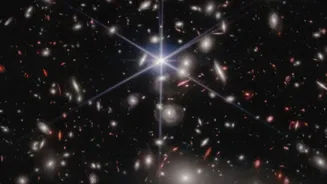
With its vast field of view, Roman is perfectly suited to tackle some of the biggest questions in cosmology. Two of its primary goals are to investigate dark energy and dark matter. Dark energy is the mysterious force thought to be causing the expansion of the universe to accelerate, while dark matter is the unseen material that provides the gravitational scaffolding for galaxies. By mapping the distribution of billions of galaxies across cosmic time, Roman will help scientists understand the nature of these invisible components that make up most of our universe. The telescope is also set to revolutionize the hunt for exoplanets. Using a technique called gravitational microlensing, Roman will monitor hundreds of millions of stars, expecting to discover thousands of new planets, including rogue planets that drift through the galaxy without a host star. It will also carry an advanced Coronagraph Instrument, a technology designed to block the blinding glare of stars to directly image Jupiter-sized planets orbiting them.