









A New Blueprint For Tech Talent
A quiet but significant revolution is reshaping technical education across India. Spearheaded by government bodies like the All India Council for Technical Education (AICTE) and the University Grants Commission (UGC), a major push is on to integrate high-end
technology courses directly into university curricula. This isn't just about adding another subject; it's a fundamental overhaul designed to produce industry-ready graduates in cutting-edge fields. The most prominent example is the academic support for the India Semiconductor Mission (ISM). Universities are now actively encouraged, and in some cases mandated, to offer specialised courses in semiconductor design, VLSI (Very Large Scale Integration), and embedded systems. This move aims to cultivate a vast talent pool capable of designing and manufacturing chips, a skill historically confined to a select few. Similar initiatives are rolling out for Artificial Intelligence, Data Science, and cybersecurity, aligning higher education with national strategic goals.
The Corporate Training Bottleneck
For decades, gaining expertise in niche technology areas like chip design or advanced AI often meant securing a job at a multinational corporation first. These companies would invest heavily in training new hires, creating their own skilled workforce through intensive, in-house programmes. While effective, this model created a closed ecosystem. Access to this critical knowledge was limited to a small group of employees at large firms, leaving a vast majority of engineering graduates without exposure. This reliance on corporate training also placed a significant burden on companies, who had to dedicate substantial time and resources to get new recruits up to speed. It created a talent bottleneck, where the growth of the industry was constrained by the training capacity of a few major players.
Democratising Deep Tech Skills
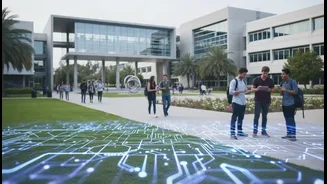
By embedding these advanced subjects into standard B.Tech and M.Tech programmes, the new university-led approach effectively democratises access to deep-tech skills. Students from hundreds of colleges, not just the elite IITs, will now have the opportunity to learn the fundamentals of semiconductor physics, chip architecture, and AI modeling as part of their formal education. Government initiatives are providing colleges with access to expensive, industry-standard Electronic Design Automation (EDA) software, which is essential for chip design. This ensures that students are not just learning theory but are getting hands-on experience with the same tools used by professionals. This shift makes high-end skills more affordable and accessible, opening up career paths for a much broader and more diverse group of students across the country.
Industry's Strategic Advantage
This educational pivot is not just a win for students; it’s a strategic advantage for the entire Indian tech industry. With universities producing graduates who already possess foundational skills in these high-demand areas, companies can reduce their training lead times and costs significantly. It creates a much larger and more robust talent pipeline, which is crucial for attracting global investment and fostering a vibrant local startup ecosystem. A wider availability of skilled engineers in areas like semiconductor design and AI will enable India to move up the value chain, from being a consumer of technology to a creator and innovator. This aligns with the 'Make in India' and 'Atmanirbhar Bharat' missions, aiming to establish the nation as a self-reliant technology and manufacturing hub.
Challenges on the Road Ahead
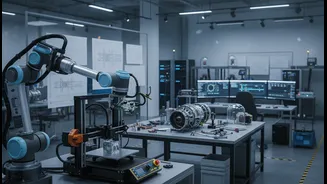
Despite the ambitious vision, the path forward has its challenges. A key hurdle is the shortage of qualified faculty to teach these specialised subjects. To address this, AICTE has launched extensive Faculty Development Programs. Another significant challenge is providing the necessary infrastructure, such as advanced labs and clean rooms, which are prohibitively expensive. Collaborations between universities, industry, and government are proving essential to bridge this gap, with some institutions partnering directly with companies for lab access and curriculum design. Furthermore, the curriculum must be constantly updated to keep pace with the rapid evolution of technology, requiring a level of agility not traditionally associated with academic institutions.