



The Classic Tale of a Cosmic Crash
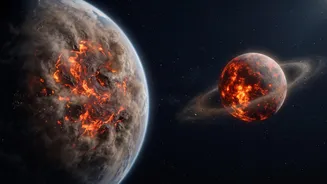
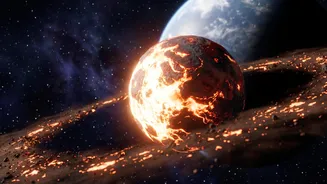
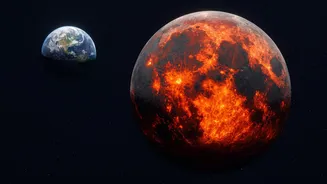
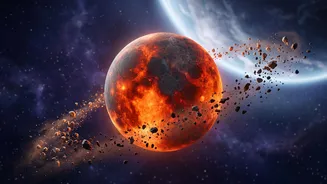
The most widely accepted story for the Moon's origin is the Giant-Impact Hypothesis. First proposed in the 1970s, it paints a dramatic picture: about 4.5 billion years ago, a Mars-sized planet, nicknamed Theia, slammed into a young, molten Earth. This
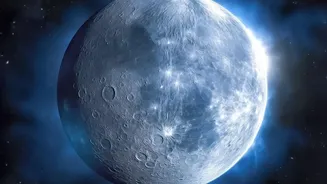
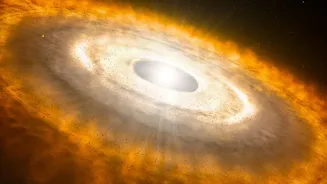
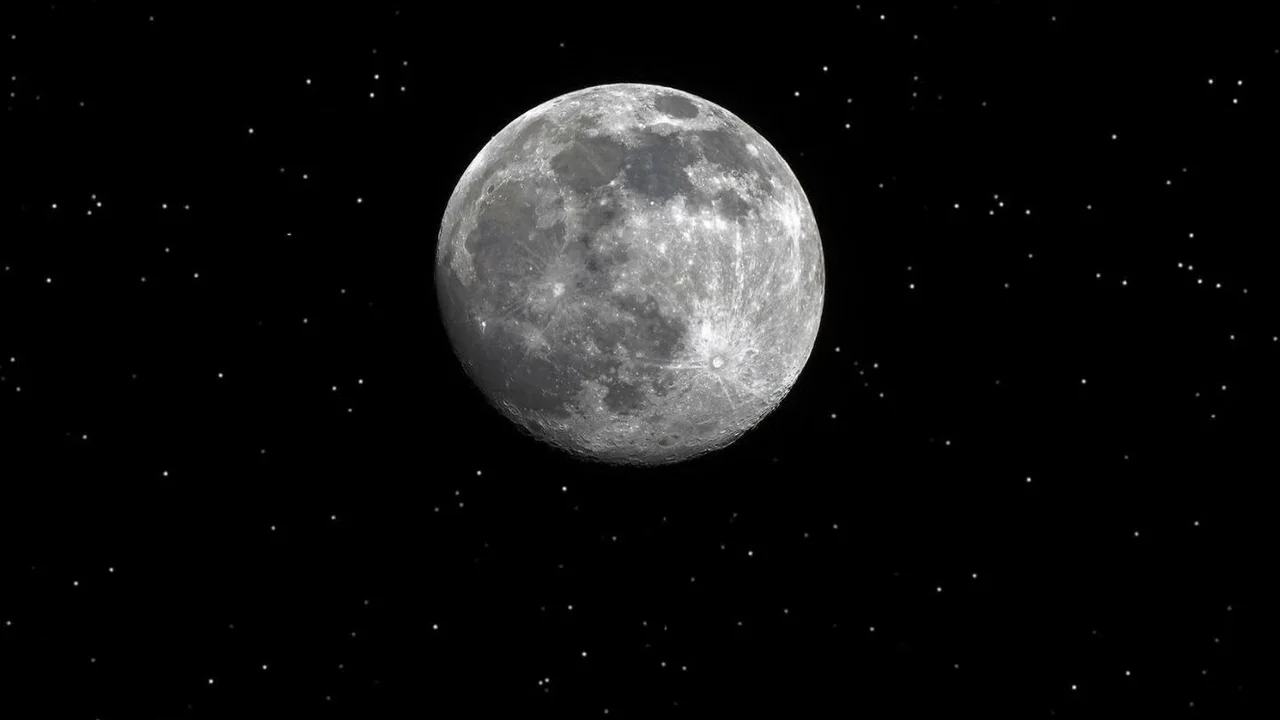
wasn't a head-on collision but a massive, glancing blow that vaporised the smaller planet and blasted a huge cloud of molten rock and debris into orbit. Over thousands or even millions of years, gravity worked its magic, causing this debris ring to slowly clump together, eventually forming the Moon we know today. This theory elegantly explains several key features of the Earth-Moon system, such as the Moon's lack of a large iron core and the high angular momentum of its orbit.
A Lingering Cosmic Puzzle
While the Giant-Impact Hypothesis has been the leading contender for decades, it has one major, persistent problem: composition. When scientists analyzed the lunar rocks brought back by the Apollo missions, they found something startling. The isotopic signatures of the rocks were almost identical to those on Earth. If the Moon was formed mostly from the debris of Theia, as the classic models suggested, it should have a distinct chemical fingerprint from its parent planet. Scientists have proposed various explanations, such as Theia and Earth happening to form from the same primordial materials, or a much more violent impact that thoroughly mixed the two bodies, but these ideas present their own set of problems. This compositional conundrum has left a crack in the foundation of our favourite lunar origin story.
A New Theory, Born in a Supercomputer
Enter the age of supercomputers. Researchers at institutions like NASA and Durham University are now running simulations of the giant impact at incredibly high resolutions, with some using up to 100 million particles to model the event. These powerful new models have revealed a stunning alternative. Instead of forming a debris disk that slowly coalesces, some simulations show a large, intact proto-Moon being launched directly into a stable orbit within a matter of hours. This isn't a slow birth over millennia; it's a cosmic delivery in less time than a workday. This 'immediate moon' scenario provides a potential solution to the composition puzzle. If a large chunk of Earth's mantle was sheared off and became the bulk of the Moon, it would naturally explain why their compositions are so similar.
The Key Qualification to Keep in Mind
This is where the headline's crucial caveat comes in: these are simulations. They are incredibly sophisticated models that show what is physically possible, but they are not definitive proof of what actually happened. The outcome of the simulated impact depends heavily on the initial conditions, particularly the temperature and material strength of the proto-Earth and Theia. Researchers found that if the colliding bodies were hotter and therefore softer, they were more likely to produce an intact Moon almost instantly. If they were cooler and more rigid, the collision was more likely to create the classic debris disk. So, while the 'immediate moon' is a fascinating possibility that elegantly solves some problems, it remains one possible outcome among many. It's a powerful new clue, but not yet the final answer in this cosmic detective story.
Why This New Story Matters
This new research does more than just offer a faster timeline for the Moon's birth. It fundamentally reframes our understanding of planetary collisions and opens up a whole new range of possibilities for the Moon's early evolution. A Moon that forms rapidly and hot would have a different internal structure and geological history than one that assembled slowly and cooled over a longer period. This new theory offers testable predictions. Future lunar missions, like those under the Artemis program, could gather rock samples from deeper within the Moon or from its far side. Analysing these new samples could provide the physical evidence needed to confirm whether our Moon was born in a flash of cosmic violence or through a long and patient process of assembly. The mystery isn't solved, but the clues are getting more exciting than ever.