



A Sweet Discovery in the Stars
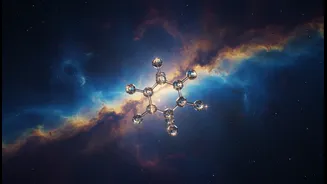
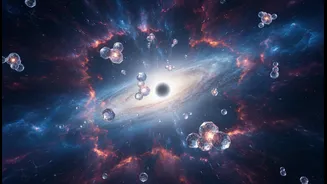
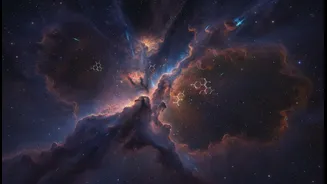
In a gas and dust cloud located 27,000 light-years away near the heart of our Milky Way, astronomers have detected a molecule named erythrulose. While it might sound obscure, this four-carbon sugar is a significant find. It is the first time a 'true'
sugar—defined as having at least three carbon atoms—has been identified in the interstellar medium, the raw material that forms stars and planets. Researchers from Spain's Center for Astrobiology used two powerful radio telescopes to spot the faint radio 'fingerprint' of erythrulose in a cloud known as G+0.693-0.027. On Earth, traces of this same sugar can be found in red raspberries. While simpler, related molecules had been seen before, this discovery confirms that more complex organic compounds can exist in the frigid, empty expanse of space.
An Essential Ingredient for Life
Finding sugar in space is about more than just a cosmic sweet tooth; it's about the very origins of life. Sugars are fundamental building blocks for living organisms. They are crucial components of RNA and DNA, the molecules that carry genetic instructions. For example, ribose is the 'R' in RNA and deoxyribose is the 'D' in DNA. While erythrulose is not directly one of these, its presence demonstrates that the chemical pathways to produce life's essential ingredients can operate in the harsh conditions of deep space. This suggests that when planets like Earth were forming, they could have been 'seeded' with these ready-made organic compounds delivered via comets and asteroids, potentially jump-starting the process that led to biology.
Rewriting the Cosmic Cookbook
The discovery was not just significant, it was also surprising. Most theories of astrochemistry suggest that complex molecules form incrementally, adding one carbon atom at a time. Following that logic, scientists had been searching for simpler three-carbon sugars but came up empty. The detection of the more complex, four-carbon erythrulose suggests a different chemical pathway might be at play. One leading hypothesis is that erythrulose formed when two smaller, two-carbon molecules—which are known to be relatively abundant in space—combined on the surface of icy dust grains. This unexpected result challenges existing models and opens up new possibilities for how the building blocks of life are assembled across the galaxy.
What This Means for the Search for Life
To be clear, astronomers have not found aliens or even evidence of past life. What they have found is a crucial piece of the puzzle of how life might begin. The discovery reinforces the idea that the chemical toolkit for life is not unique to our planet but is instead universal. If the basic ingredients—sugars, amino acids, and water—are common throughout star-forming regions in the galaxy, it raises the tantalizing possibility that life itself could be widespread. The finding provides a compelling reason to continue searching for these prebiotic molecules in other star systems and even closer to home, in the asteroids and comets within our own solar system. Every molecule identified adds another word to the story of our cosmic origins.