

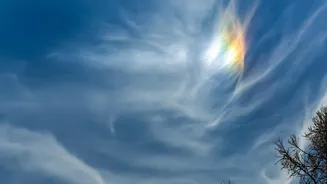
Not Fire, Not a Rainbow
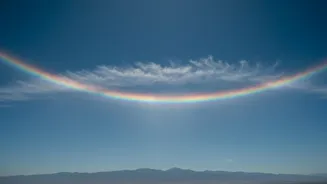
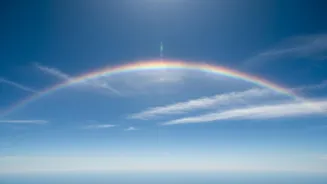
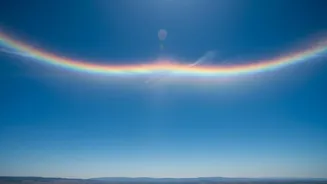
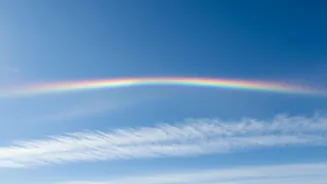
First, let's clear the air. The term 'fire rainbow' is a misnomer, though an evocative one. This stunning display has nothing to do with fire and isn't technically a rainbow in the traditional sense. Its scientific name is a circumhorizon arc, or circumhorizontal
arc. The name comes from its appearance as a colourful arc that runs parallel to the horizon. The 'fire' part of its nickname likely comes from its vibrant, flame-like appearance when it lights up wispy, patchy clouds.
A Recipe of Sun and Ice
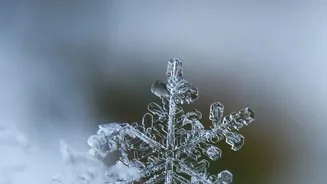
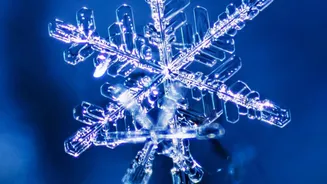
So, what creates this spectacle? The phenomenon is a type of ice halo, and it requires a very specific set of ingredients to occur. The two crucial components are the Sun's position and the presence of a particular type of cloud. You need high-altitude cirrus or cirrostratus clouds, which are thin, wispy clouds found over 16,000 feet up where temperatures are freezing. Because it is so cold, these clouds are not made of water droplets like lower-level clouds, but are instead composed of millions of tiny, hexagonal (six-sided) ice crystals.
The Perfect Alignment
Even with the right clouds, a fire rainbow will not appear unless the geometry is just right. First, the Sun must be very high in the sky, at an elevation of at least 58 degrees above the horizon. This is why fire rainbows are more common in mid-latitudes during the summer months and are impossible to see in northern regions above 55 degrees latitude. Second, the millions of plate-shaped, hexagonal ice crystals within the cirrus cloud must be aligned horizontally, floating flat like tiny dinner plates suspended in the atmosphere.
How the Colours Form
When all these conditions are met, a beautiful act of physics takes place. Sunlight enters the vertical side face of a horizontal ice crystal and is bent, or refracted. It then exits through the crystal's flat bottom face, bending again. This 90-degree path acts like a prism, splitting the white sunlight into its constituent colours. Because millions of crystals are all aligned in the same way, they collectively refract the light, creating a broad, brilliant band of pure spectral colours that appears to paint the cloud. The red light is always on top, with violet at the bottom.
Distinguishing from Other Phenomena
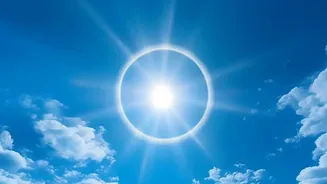
A circumhorizon arc is often confused with other atmospheric optical effects, most commonly iridescent clouds. While both are colourful, iridescence is caused by diffraction of light by water droplets or smaller ice crystals and results in more random, pastel, 'mother-of-pearl' colours. A fire rainbow, by contrast, has clean, well-separated spectral colours. It's also different from a regular rainbow, which is formed by light refracting and reflecting inside liquid water droplets and always appears in the part of the sky opposite the sun. Other ice halos like sundogs or circumzenithal arcs also appear in different positions relative to the Sun.