






Hiding in Plain Sight
For decades, the object known as IRAS 18293-0941 was just another entry in an astronomical catalogue, first noted in 1983. Shrouded by thick interstellar dust, its true nature remained a secret, effectively invisible to most telescopes. But after years
of searching for a theorized class of object, a team of international astronomers decided to take a closer look. Using a combination of powerful radio telescopes like the MeerKAT array in South Africa and the European VLBI Network, they pierced through the dusty veil to reveal something extraordinary. What they found was not a distant galaxy, but a system within our own Milky Way: a stellar-mass black hole, about ten times the mass of our sun, locked in a gravitational dance with a massive companion star.
What is a Microblazar?
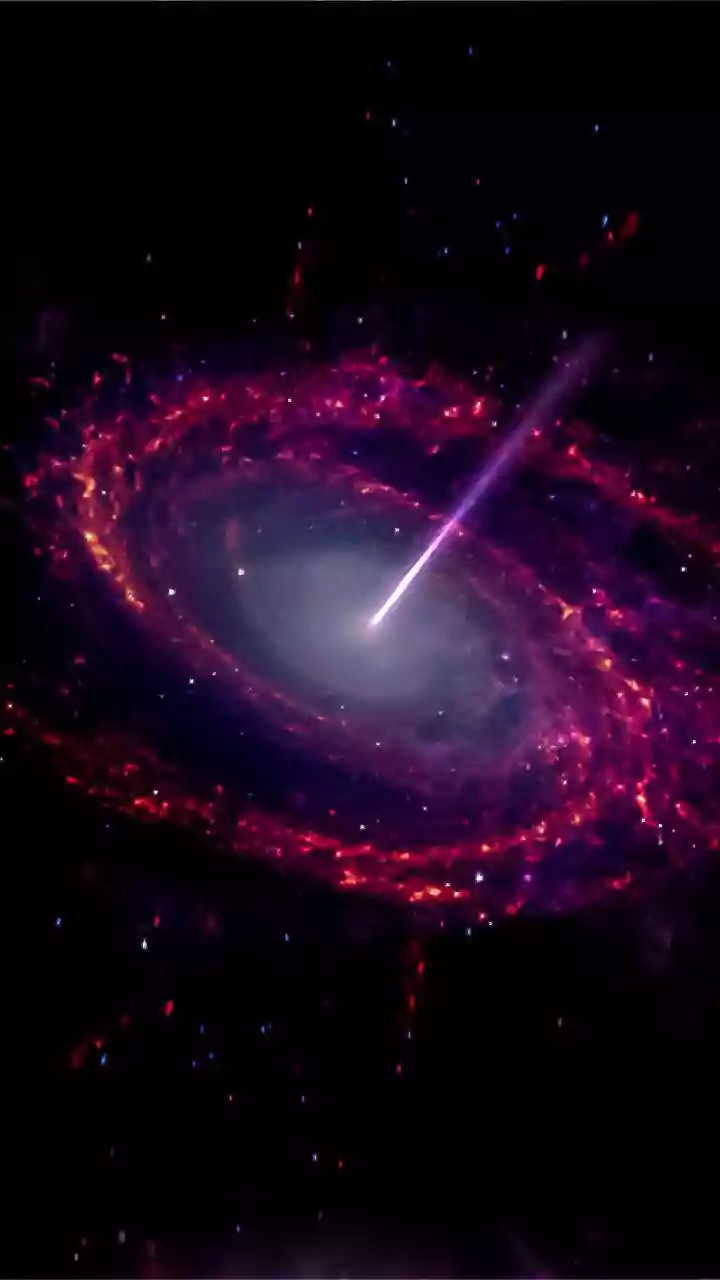
To understand a microblazar, it helps to first know its much bigger cousin: the blazar. Blazars are among the most energetic phenomena in the universe. They occur when a supermassive black hole, millions or billions of times the mass of our sun, sits at the center of a galaxy, feeding on surrounding gas and stars. As this material spirals in, some of it is funnelled by intense magnetic fields and shot out from the black hole's poles in colossal jets of plasma travelling at nearly the speed of light. When one of these jets happens to be pointed directly at Earth, we call it a blazar. A microblazar is the exact same phenomenon, but in miniature. Instead of a supermassive black hole, it involves a much smaller stellar-mass black hole feeding on a single companion star. The discovery of IRAS 18293-0941 marks the first strong candidate for this long-sought-after cosmic object.
A Cosmic Engine of Incredible Speed
In the IRAS 18293-0941 system, the black hole and its companion star orbit each other every 11.38 days. During this cosmic dance, the black hole's immense gravity strips material from the star. This stolen gas forms a swirling, superheated accretion disk around the black hole before some of it is violently ejected. The result is a pair of jets, firing in opposite directions at a staggering 75% of the speed of light. Because one of these jets is aimed almost directly at us, the effects of relativity make it appear incredibly bright, a phenomenon known as Doppler boosting. This same effect makes the jet pointing away from us nearly invisible. While the idea of a high-speed particle jet aimed at Earth might sound alarming, scientists have confirmed there is absolutely no danger. At a distance of 12,000 light-years, it is far too remote to have any effect on our planet.
A Laboratory for Extreme Physics
The real excitement around this discovery lies in what it can teach us. Blazars are so distant that it's impossible to study their physics in detail. Microblazars, being in our own galaxy, offer a local laboratory to study these extreme processes. Because they are so much smaller, their life cycles are vastly accelerated. Changes that might take centuries in a blazar could happen over weeks or months in a microblazar, allowing astronomers to observe cosmic evolution on a human timescale. Furthermore, astronomers believe the jet from IRAS 18293-0941 could be a cosmic particle accelerator. As the jet slams into a nearby cloud of interstellar gas, it may be accelerating particles to energies 100 times greater than what can be achieved at the Large Hadron Collider on Earth. This could help explain the origin of some of the mysterious ultra-high-energy cosmic rays detected in our galaxy.