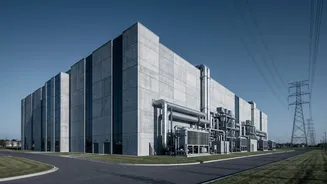








Artificial Intelligence is everywhere, but its rapid growth is powered by something largely invisible: massive data centres. As businesses adopt AI, they must confront the technology's enormous and fast-growing appetite for energy.
The Soaring Energy Demands of AI
Data centres, the engine
rooms of the digital world, were already significant energy consumers, accounting for 1-2% of global electricity use before the AI boom. But the widespread adoption of AI is causing this demand to skyrocket. Projections indicate that electricity consumption by data centres could double between 2022 and 2026, with some estimates suggesting it could reach 21% of global demand by 2030. The reason for this surge lies in the nature of AI workloads. Training and running large AI models, especially those involving images and video, is far more computationally intensive than traditional tasks. A single query on an advanced AI like ChatGPT can consume up to ten times more electricity than a standard Google search.
From CPUs to GPUs: A Power-Hungry Shift
The fundamental shift driving this energy spike is the move from Central Processing Units (CPU) to Graphics Processing Units (GPU) as the primary workhorses for AI. GPUs excel at the parallel processing required for training complex models, but they are incredibly power-dense. This means more electricity is needed for the chips themselves, and critically, more energy is required to cool them down. A traditional server rack might draw 5-15 kilowatts (kW) of power, but an AI-optimised rack packed with GPUs can demand anywhere from 30 kW to over 100 kW. This intense concentration of power and heat is straining not only the design of data centres but also the local power grids that supply them.
Beyond the Electricity Bill: Broader Business Impacts
For businesses, this isn't just a technical issue; it's a strategic one with bottom-line consequences. Rising energy consumption translates directly into higher operational costs. In some regions with high concentrations of data centres, such as Northern Virginia in the US, the strain on the grid is already becoming acute, leading to delays in connecting new facilities and rising electricity costs for all users. Furthermore, companies face growing pressure from investors, customers, and regulators to meet environmental, social, and governance (ESG) targets. The massive carbon footprint and water usage associated with power-hungry AI operations are becoming a significant reputational and compliance risk.
Innovating for Efficiency: Cooling and Measurement
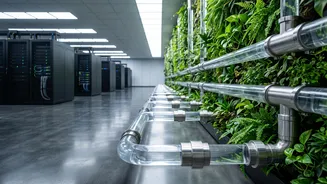
The industry is racing to innovate its way out of this power crunch. One of the most critical areas is cooling. Conventional air cooling is hitting its physical limits against racks generating over 100 kW of heat. This has accelerated the adoption of direct liquid cooling, where fluids are circulated through 'cold plates' mounted directly onto the hot GPUs to carry heat away much more effectively. At the same time, the industry is re-evaluating how it measures efficiency. Power Usage Effectiveness (PUE), the long-standing benchmark, only measures the efficiency of the facility's infrastructure (like cooling) but ignores what happens inside the server itself. New, more holistic metrics are being developed to get a truer picture of efficiency from the power grid all the way to the chip.
Smarter AI and Sustainable Operations
Beyond hardware, businesses can pursue smarter software and operational strategies. This includes developing smaller, more efficient AI models that require less power to train and run. AI itself can even be part of the solution; predictive analytics can help data centres anticipate energy needs, optimise cooling systems, and better integrate renewable energy sources like solar and wind by balancing their intermittent supply with grid power. Companies are also getting more strategic about where they build and operate, choosing locations with access to cleaner energy grids and favourable climates for cooling. These strategies, combining technical innovation with operational intelligence, are essential for sustainable scaling.