



A Priceless Cosmic Laboratory
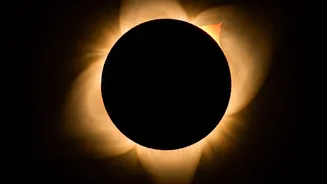
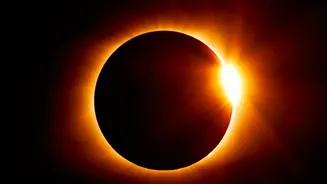
For scientists, the few minutes of a total solar eclipse are an invaluable opportunity. When the Moon perfectly blocks the Sun's blindingly bright face, the star's elusive outer atmosphere, the corona, becomes visible. This ghostly halo is millions of degrees
hotter than the Sun's surface and is the engine behind the solar wind, a stream of particles that affects our entire solar system. Observing the corona during an eclipse provides data that even sophisticated instruments called coronagraphs cannot fully capture, offering clues to the Sun's fundamental processes. Eclipses have a storied history of discovery. An 1868 eclipse led to the discovery of helium, and a 1919 eclipse provided the first major proof of Albert Einstein's theory of general relativity. Today, scientists use them to study how the sudden drop in sunlight affects Earth's upper atmosphere, particularly the ionosphere, which is crucial for GPS and radio communications.
Echoes of Myth and Omen
Long before astronomy explained the clockwork of the cosmos, cultures worldwide created powerful stories to interpret the sudden darkening of the sky. In many traditions, an eclipse was a terrifying event. The ancient Chinese believed a celestial dragon was devouring the Sun, and people would bang pots and drums to scare it away. The word 'eclipse' itself comes from a Greek word meaning 'abandonment,' as they saw it as a sign of angry gods. In Hindu mythology, the demon Svarbhanu, whose head was severed by Vishnu but remained immortal, is said to swallow the sun. This head became known as Rahu, and his eternal chase of the sun and moon is the mythological cause of eclipses. These events were often seen as inauspicious, and even today, some traditions involve fasting and staying indoors as a precaution. For many ancient peoples, an eclipse wasn't a scientific event but a moment when the cosmic order felt profoundly threatened.
The Modern Pilgrimage
Today, the fear has largely been replaced by fascination, and an eclipse has become a reason for mass gathering and celebration. The path of totality transforms into a destination for a unique kind of tourism. The 2024 total solar eclipse in North America was estimated to generate over a billion dollars in economic activity as millions travelled to witness the event. The upcoming total solar eclipse on August 12, 2026, which will cross over Spain, Iceland, and Greenland, is expected to draw hundreds of thousands of visitors, with Spain alone projecting over €340 million in additional tourism spending. This phenomenon, dubbed the "eclipse economy," sees hotels, restaurants, and local businesses in the viewing path experience a massive, if temporary, boom. It is a modern pilgrimage, driven not by ancient dread but by a collective desire to witness a celestial marvel.
A Shared Moment of Awe
Beyond the science and the economics, what truly defines the modern eclipse experience is a powerful, shared psychological effect. Studies analyzing social media activity during eclipses found a significant increase in expressions of awe, humility, and prosocial behaviour. People within the path of totality tend to feel more connected and less self-focused. The surreal twilight, the drop in temperature, and the sight of the Sun's corona create a collective sense of wonder that transcends individual concerns. It's a rare moment when crowds of strangers stand together, looking up at the same spectacle, sharing an experience that is both deeply personal and universally human. This shared awe can foster a temporary sense of community and connectedness, binding people together in a way that few other events can.