






A Cosmic Powerhouse in Miniature
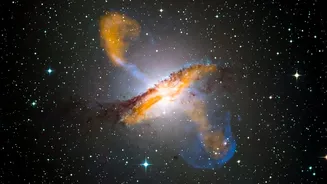
To understand the excitement, we first need to talk about blazars. A blazar is an intensely bright object powered by a supermassive black hole at the center of a galaxy. These behemoths, millions or billions of times the mass of our sun, guzzle surrounding
matter and blast out powerful jets of particles at nearly the speed of light. When one of these jets happens to point directly at Earth, we call it a blazar. A 'microblazar' works on the same principle but on a much smaller scale. Instead of a supermassive black hole, its engine is a stellar-mass black hole, perhaps only ten times the mass of our sun, which feeds on a companion star. Scientists have predicted their existence in the Milky Way for over 30 years, but finding one has proven difficult.
Hiding in Plain Sight
The candidate, named IRAS 18293-0941, was first detected by the Infrared Astronomical Satellite back in 1983. However, it was largely forgotten because it's located about 12,000 light-years away and is hidden behind thick clouds of interstellar dust, making it invisible in normal optical light. Renewed interest came from radio observations that revealed a bright source with a jet extending from only one side. This one-sided appearance was a crucial clue. When a jet travels towards us at relativistic speeds (a significant fraction of the speed of light), an effect called 'Doppler boosting' makes it appear far brighter than the jet moving away from us, creating the illusion of a single stream.
A Jet Pointed Our Way?
The phrase 'jet apparently facing Earth' is what makes this discovery so compelling. But before anyone panics, it's important to understand the scale. The system is around 12,000 light-years away, a vast cosmic distance that removes any realistic threat to our planet. Scientists have confirmed there is no danger. The jet's alignment is not a threat, but a scientific gift. It gives astronomers a direct, face-on view of the jet's structure and the physics of how it's launched. This makes IRAS 18293-0941 a unique 'cosmic laboratory' in our own galactic backyard, allowing for studies in far greater detail than possible with distant blazars that are millions or billions of light-years away.
A Cosmic Particle Accelerator
The system consists of a black hole about 10 times the sun's mass orbiting a massive companion star every 11.4 days. The black hole strips material from the star, and while much of it falls in, some is channeled into two opposing jets that blast outwards at about 75% of the speed of light. The jet pointing away from us is not seen directly, but astronomers using the MeerKAT radio observatory in South Africa detected its impact. It's slamming into a massive molecular cloud about 100 light-years away, creating a 'hotspot' that acts as a powerful natural particle accelerator, creating energies 100 times greater than what can be achieved at the Large Hadron Collider. This could help solve a long-standing mystery about the origin of some of the most energetic particles, called cosmic rays, found in our galaxy.