


The Satellite Boom
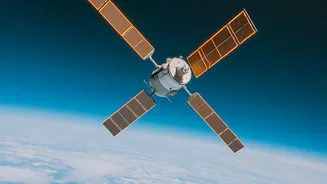
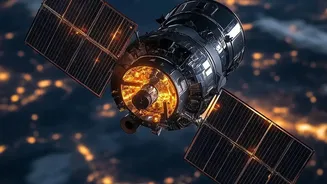
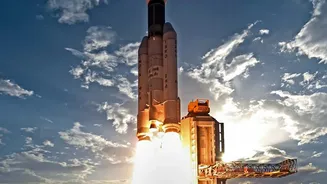
Just a decade ago, the idea of a global internet service beamed from space seemed like science fiction. Today, it’s a rapidly growing reality, thanks to the rise of satellite mega-constellations. Companies like SpaceX with its Starlink network, and Amazon
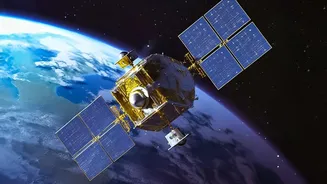
with its planned Project Kuiper, are launching satellites at an unprecedented rate. The number of active satellites has exploded from a few thousand in the late 2010s to well over 18,000 as of mid-2026. The majority of these are in Low Earth Orbit (LEO), a region up to 2,000 kilometres above us, ideal for low-latency communications. This satellite market is projected to grow into a multi-billion dollar industry, transforming global connectivity and creating enormous business opportunities in launch services and ground infrastructure.
The Junkyard Above
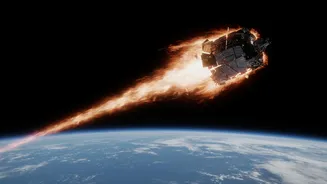
Every rocket launch and satellite deployment leaves something behind. The space around our planet is now cluttered with not just active satellites, but also defunct ones, spent rocket stages, and millions of smaller fragments from past collisions and breakups. Trackers are currently monitoring over 29,000 objects larger than 10 centimetres. However, statistical models estimate there are over a million objects between 1 and 10 centimetres, and more than 140 million fragments smaller than 1 centimetre. At orbital speeds exceeding 28,000 kilometres per hour, even a paint fleck can inflict catastrophic damage on an operational spacecraft. This orbital debris represents a collective legacy of over six decades of space activity, a problem that is accelerating with the current commercial boom.
A Game of Orbital Roulette
The sheer volume of debris creates a hazardous environment for the very satellites our modern world depends on for GPS, weather forecasting, financial transactions, and communications. Each piece of junk is a bullet in a high-stakes game of orbital roulette. The greatest fear is a chain reaction known as the Kessler Syndrome, a theory proposed by NASA scientist Donald Kessler in 1978. It describes a scenario where the density of debris becomes so high that one collision generates a cloud of new fragments, which in turn cause more collisions, leading to a cascade that could render entire orbital highways unusable for generations. While we are not yet in a full-blown cascade, experts warn that the most congested orbital bands, particularly between 700 and 1,000 km, are already showing signs of instability.
The Wild West of Orbit
Part of the problem is that the rules governing space are outdated. The 1967 Outer Space Treaty holds nations responsible for their space objects but was not designed for an era of private mega-constellations. International guidelines, such as the 25-year de-orbit rule which suggests satellites should be removed from orbit within 25 years of their mission's end, are largely voluntary and have a low compliance rate. Recognizing this, the U.S. Federal Communications Commission (FCC) recently mandated a stricter five-year rule for its licensees, a step towards more responsible management. However, without a globally binding treaty and enforcement mechanism, Low Earth Orbit remains a kind of Wild West, where the collective good is often at odds with individual commercial interests.
The Billion-Dollar Cleanup
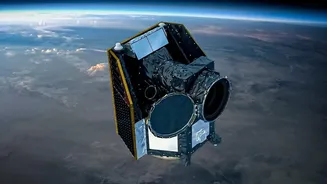
The growing threat has spurred a new market: orbital debris removal. A number of startups and established aerospace players are developing innovative, if expensive, solutions. Japan's Astroscale and the Swiss company ClearSpace are both pioneering missions to demonstrate the ability to capture and de-orbit defunct satellites. Other proposed technologies include giant nets, harpoons, magnetic capture systems, and even ground-based lasers to nudge debris off a collision course. Portal Space Systems and Paladin Space are collaborating on a service to remove multiple objects in a single mission. These efforts are technologically complex and costly, but represent the first steps toward actively cleaning up our orbital backyard, rather than just trying not to make it worse.