





The Icy Moon With a Fiery Heart
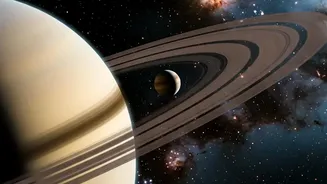
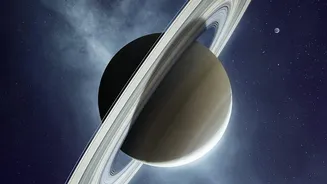
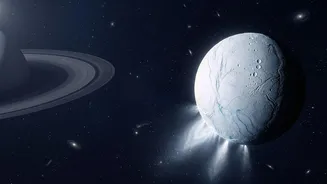
From a distance, Enceladus looks like a quiet, unassuming ball of ice, only about 500 kilometers in diameter. But thanks to NASA's Cassini mission, which orbited Saturn for over a decade, we know this tiny moon is one of the most dynamic and intriguing
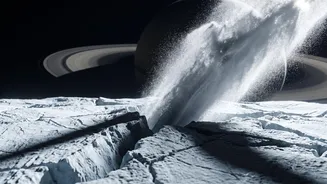
worlds in our solar system. Its most stunning feature is the giant plumes of water vapor and ice grains that erupt from deep fissures near its south pole, known as "tiger stripes." These geysers shoot hundreds of kilometers into space, providing scientists with an incredible gift: direct samples of a hidden, subsurface ocean without ever needing to drill through its thick ice crust. Analysis of these plumes has revealed a global saltwater ocean interacting with a rocky core, likely heated by hydrothermal vents similar to those found on Earth's own ocean floors.
A Recipe for Life?
The search for extraterrestrial life often starts with a simple checklist: liquid water, essential chemical elements, and an energy source. Enceladus appears to have all three. Cassini's flybys detected salts, methane, complex organic compounds, and even phosphorus and hydrogen cyanide—molecules considered crucial for the building blocks of life. The presence of molecular hydrogen, in particular, points to ongoing chemical reactions between the water and rock on the seafloor. This process could provide a steady source of chemical energy, much like the hydrothermal vents on Earth that support entire ecosystems teeming with life, completely independent of sunlight. This tantalizing chemical cocktail has made Enceladus a primary target for astrobiologists, but a critical question has remained: could anything actually live there?
Putting Earth Life to the Test
To find an answer, a team of researchers led from Ludwig-Maximilians-Universität in Munich decided to bring Enceladus to Earth—in a lab. They meticulously recreated the conditions believed to exist near the hydrothermal vents on Enceladus's ocean floor. The simulated environment was completely without oxygen, highly alkaline with a pH up to 11 (similar to some household cleaners), and rich in carbonates and minerals designed to mimic the moon's rocky core. Into this alien brew, they introduced an Earthly organism: Methanothermococcus okinawensis. This microbe, a type of archaeon, was originally discovered near a deep-sea hydrothermal vent in the waters off Japan. It's a methanogen, meaning it survives by consuming hydrogen and carbon dioxide to produce energy, releasing methane as a waste product—a metabolic process believed to be one of the most ancient on Earth.
Surviving Against the Odds
The results of the experiment surprised even the scientists. While M. okinawensis struggled to grow in a standard lab medium at such high alkalinity, it not only survived but thrived in the Enceladus simulation. The key was the geochemistry of the simulated environment. The chemical reactions between the water and powdered rock continuously produced hydrogen, providing a reliable fuel source for the microbes. Even more impressively, the organisms adapted their metabolism to function with the very low levels of available carbon dioxide, a major challenge in such an alkaline sea. By tracking isotopes, researchers confirmed the microbes were actively producing methane, proving that this biological process is possible under Enceladus-like conditions.
Habitability is Not Proof of Life
This groundbreaking result is a major step forward, but it's crucial to understand what it does—and does not—mean. The study provides powerful evidence that Enceladus is habitable; its environment can theoretically support living organisms. It removes a major barrier by showing that life, or at least a form of it we understand, can overcome the moon's extreme chemistry. However, this is not proof that life actually exists there. The moon remains uninhabited as far as science can establish. The experiment demonstrates possibility, not reality. It shows that if a methanogen-like organism were ever to arise on Enceladus, it could potentially survive. This distinction is at the heart of the scientific process: slowly and carefully building a case, one piece of evidence at a time.
What Comes Next in the Search?
The findings significantly strengthen the case for future missions to Saturn's intriguing moon. Scientists now have a clearer idea of what biosignatures—chemical traces of life—to look for. A future spacecraft could be designed with instruments specifically tuned to distinguish between methane produced by biological processes versus geological ones. Proposals for such missions are already in development, including the Enceladus Orbilander concept, which would orbit the moon and repeatedly fly through its plumes to collect higher-quality samples. For now, the study gives scientists renewed optimism and a specific, testable hypothesis. It transforms Enceladus from a place that might be habitable to a world where a known lifeform could survive.