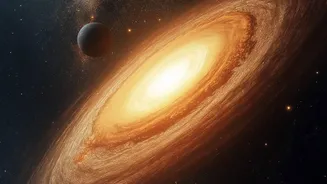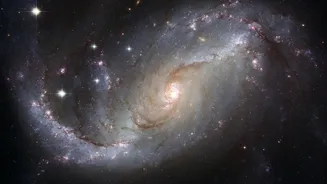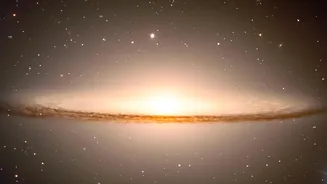






A Galactic Slowdown
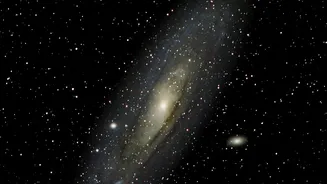
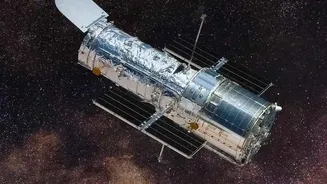
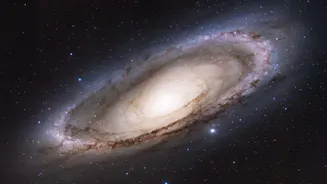
Imagine a sprawling city that slowly stops building new homes. That’s essentially what’s happening 2.5 million light-years away in the Andromeda galaxy. New research using data from NASA's Hubble Space Telescope has given astronomers the most detailed
look yet at our neighbour's recent history. By analysing around 200 million individual stars across its vast disk, scientists have confirmed that Andromeda's star formation has been on a steady decline for the last 500 million years. The slowdown has become even more pronounced in the last 40 million years. About 500 million years ago, the galaxy was churning out new stars at a rate of about one solar mass per year. Today, that rate has plummeted to just one-fifth of a solar mass annually. This doesn't mean the galaxy is dying—it still has a trillion stars shining brightly—but it is entering a quieter, more mature phase of its life.
Reading the Stellar Fossil Record
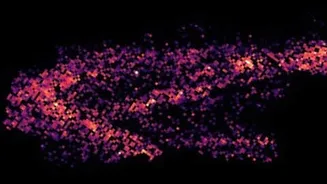
So, how do scientists read the history of a galaxy? They look at the stars themselves. Massive, young stars burn incredibly hot and bright, giving off a distinct blue light. However, they live fast and die young. Older, less massive stars are cooler and glow with a redder hue, and they can shine for billions of years. By mapping the colours of stars across Andromeda, astronomers can create a “fossil record” of its activity. Regions filled with brilliant blue stars are cosmic nurseries where stars have been born recently. Areas dominated by redder stars are galactic suburbs where construction has long since ceased. The Hubble data allowed researchers to divide the galaxy into thousands of sections and analyse the star-birth history in each one, revealing a galaxy-wide trend of decreasing activity.
Not Out of Fuel, Just Taking a Breather
The most obvious reason for a slowdown in star formation would be a lack of raw materials—the vast clouds of gas and dust that collapse to form new suns. However, studies show this isn’t the case for Andromeda. The galaxy still has plenty of fuel in its tank. Instead, the decline appears to be a natural winding down after a much more energetic period. About two billion years ago, Andromeda experienced a massive burst of star formation, likely triggered by a collision or merger with a smaller galaxy. The current slowdown is like a long, cosmic exhale after a period of intense activity. As one lead researcher put it, it's like taking a breather after running a marathon. Much of the recent decline is driven by fading activity in a prominent star-forming ring located about 32,000 light-years from the galactic centre.
A Galactic Whodunnit?
While the slowdown is largely a natural process, astronomers have identified a prime suspect that may have helped accelerate it: Andromeda’s small satellite galaxy, Messier 32 (M32). Researchers noted that the area of Andromeda's disk near M32 shows a more significant decrease in star formation that began around 60 million years ago. This timing could align with a past interaction where M32 plunged through Andromeda's disk. Such an event could disrupt the delicate gas clouds, either triggering a brief burst of star birth or scattering the material and effectively shutting down the stellar nurseries in its path. While scientists can't yet definitively blame M32, they say it is the most likely external factor contributing to the slowdown.
A Glimpse into Our Own Future
Studying Andromeda isn’t just an academic exercise; it provides a preview of what might be in store for our own Milky Way. The two galaxies are on a collision course, predicted to merge in about 4.5 to 6.5 billion years to form a new, giant elliptical galaxy sometimes dubbed "Milkomeda". Understanding Andromeda's evolution helps us model the future of this galactic super-structure. Our Milky Way is currently more active, producing about three to five solar masses worth of stars per year, significantly more than Andromeda. But eventually, it too will exhaust its most active star-forming regions and settle into a more sedate existence. Andromeda’s current state shows us what the long, graceful aging process of a spiral galaxy looks like.