


A Vision of a City Reimagined
Forget everything you know about dark, utilitarian subway stations. As part of its ambitious Vision 2030 plan, Saudi Arabia is turning Riyadh into a gallery without walls, and its new metro system is the main exhibition hall. The Riyadh Metro is not just
one of the world's largest public transport projects; it's a statement. The goal is to blend seamless functionality with breathtaking beauty, turning everyday travel into an experience. The city has enlisted some of the planet's most celebrated architects to design stations that do more than just move people—they inspire them. This network of 85 stations aims to alleviate traffic, but also to enrich the lives of residents and visitors by making art and culture an integral part of the urban landscape. It's a civic art initiative on an epic scale, embedding creativity into the very infrastructure of daily life.
Architecture Inspired by Desert Winds
At the heart of this transformation is the King Abdullah Financial District (KAFD) Metro Station, a masterpiece by the legendary Zaha Hadid Architects. The design looks less like a station and more like a land sculpture. Its futuristic, flowing lines are directly inspired by the patterns that desert winds carve into sand dunes. The building's façade is a latticework of concrete panels with geometric cutouts that create a dappled light effect inside, a modern interpretation of traditional Arabian environmental shelters that provide shade from the intense sun. This is not just about aesthetics; the design is incredibly smart. It was shaped by data mapping passenger flow to ensure smooth circulation and prevent crowding. As a key interchange connecting multiple metro lines and the airport, it’s a vision of the future that is deeply rooted in the natural forms of its surrounding landscape.
An Urban Oasis of Green
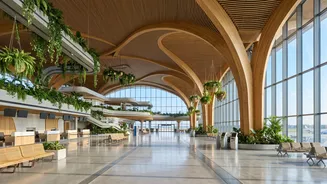
Another standout is the Olaya Metro Station, designed by German firm Gerber Architekten. While the KAFD station evokes the flowing dunes, Olaya creates a literal oasis in the heart of the city. The entire building is conceived as a giant, undulating public garden. The roof is a landscaped park, planted with palm trees and dotted with water features, that seems to rise gently from the ground. This green space provides a much-needed public park in a dense urban area, creating a place for community and relaxation right on top of a major transit hub. Below the surface, natural light floods the multi-level station, which integrates not just train lines but also retail spaces. It beautifully resolves the challenge of building massive infrastructure by giving back to the city with an accessible and lush public park, establishing a dialogue between tradition and the future.
Where History and Heritage Converge
The new metro system also pays deep respect to the city’s past. Located in Riyadh’s historic core, the Qasr Al Hokm station, designed by Snøhetta, is a bridge between the city's rich heritage and its forward momentum. Its most stunning feature is a massive, polished stainless-steel canopy that hovers over the plaza, providing critical shade while reflecting the sky and surrounding historic buildings. Inside, the design incorporates intricate patterns inspired by traditional Najdi architecture, connecting commuters to the region's cultural identity. Nearby, the National Museum Station, designed by Arup, features a stunning lattice shell inspired by the landscape of the Tuwaiq mountains. These stations are more than just transit points; they are carefully considered public spaces that honor Saudi heritage, with some even featuring unexpected elements like a lush garden planted 35 meters underground.
Commuting Through a World-Class Gallery
Beyond the architecture itself, the Riyadh Art program is transforming these stations into permanent showcases for world-class art. At the KAFD station, commuters will encounter a vibrant, kinetic sculpture by Alexander Calder and the iconic 'LOVE' sculpture by Robert Indiana. The program is placing major artworks throughout the network, featuring Saudi and international talent, including a notable piece by Indian artist Subodh Gupta. This initiative effectively turns the capital into an open-air museum, where masterpieces are not confined to galleries but are woven into the fabric of daily life. It reflects a profound belief that art should be for everyone, enriching the urban landscape and sparking creativity at every turn.