




A Mission to Listen
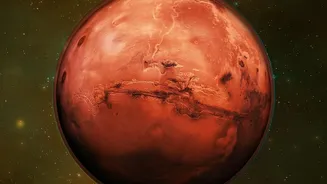
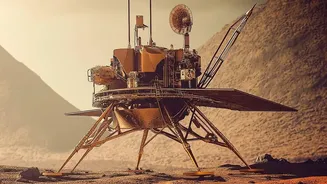
Before NASA’s InSight mission touched down in 2018, our knowledge of Mars was largely skin-deep. Rovers and orbiters had studied its surface, but its heart remained a mystery. InSight’s job was to change that. Unlike a rover, it was a stationary science
platform designed to take the planet’s pulse. Its key instrument, the Seismic Experiment for Interior Structure (SEIS), was an incredibly sensitive seismometer designed to listen for “marsquakes.” By studying how seismic waves travelled through the planet, scientists hoped to map its interior for the first time—from crust to core. The mission, which concluded in late 2022, was a stunning success, recording over 1,300 seismic events and giving humanity its first-ever checkup of the Martian interior.
A Crust with a History
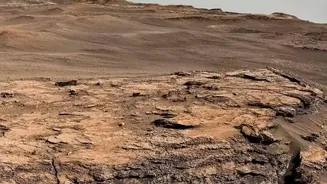
One of the first surprises was the Martian crust. Instead of being a single, uniform shell, scientists found it was thinner than expected and likely composed of two or even three distinct layers. Analysis of seismic waves from a powerful magnitude 4.7 marsquake showed that vibrations travelled differently horizontally than vertically, pointing to a stratified structure formed by different geological events over time, such as ancient volcanic eruptions or massive impacts. Furthermore, a 2026 study published in Nature Astronomy suggests Mars once hosted vast, interconnected magma systems deep within its crust. This challenges the old idea that Mars only had isolated volcanoes and suggests the planet could form a complex, chemically diverse crust without the plate tectonics that shape Earth.
A Lumpy, Chaotic Mantle
Deeper inside, the picture gets even more interesting. The Martian mantle—the thick layer between the crust and core—is not the smooth, uniform layer often depicted in textbooks. Instead, InSight’s data suggests it’s a lumpy, irregular structure, more like a “Rocky Road brownie” than a neatly layered cake. Scientists believe these lumps are giant fragments of ancient rock, leftover debris from cataclysmic asteroid impacts that occurred some 4.5 billion years ago. These events were so powerful they melted huge portions of the young planet, injecting debris deep into the mantle where it remains preserved today. There is also evidence for a giant, active mantle plume—a column of hot rock rising from deep within—pushing up on the surface at Elysium Planitia, the very region where InSight landed.
The Mysteries of the Core
At the heart of Mars lies its most profound puzzle. Initial findings confirmed the core is molten and surprisingly large. To account for its size and lower-than-expected density, scientists proposed it must contain a high percentage of lighter elements like sulfur mixed in with the iron. One study even suggested the core is surrounded by a 150-kilometer-thick layer of liquid silicates, a feature not seen on Earth. However, as scientists analyze more data, the picture continues to evolve. Later studies using waves from quakes on the far side of the planet suggest the core may actually be smaller and denser than first thought. Another analysis even points to the possibility of a solid inner core, which would be unexpected given Mars's composition. This ongoing debate highlights just how much InSight has transformed our view from simple assumptions to complex questions.