





Feel the Fabric and Weave
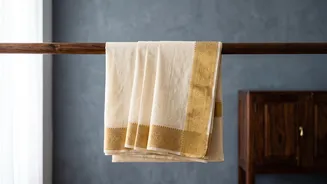
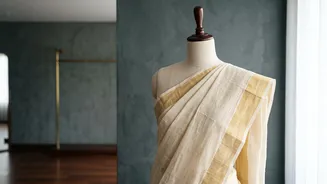
The first test of an authentic Kasavu is touch. A genuine handloom saree, typically made from high-quality cotton, feels soft, breathable, and has a certain weight to it. Unlike the uniform, stiff texture of a power loom equivalent, a handloom Kasavu will
have minor irregularities in the weave. These are not defects but the signatures of human craftsmanship, giving the fabric a unique character. Run your hand over the surface; it should feel comfortable and porous, not synthetic or plastic-like. Authentic cotton Kasavu also softens with each wash, a quality machine-made versions lack.
Examine the Zari (Golden Border)
The ‘Kasavu’ itself refers to the golden border. Authentic zari has a subtle, rich sheen, not a loud, glittery shine. There are three main types: pure zari (silver thread plated in gold), half-fine zari (copper wire with silver and gold plating), and imitation or plastic zari. A simple test is to check the reverse side of the border. In a handloom piece, the zari threads will be neatly integrated into the weave, not appearing glued or laminated. If you can examine a loose thread, a red silk or cotton core often indicates genuine or half-fine zari, while a white core suggests a synthetic imitation.
Look for the Handloom Mark
To be certain of your purchase, look for official certifications. The Government of India provides a 'Handloom Mark' to guarantee authenticity. More recently, the Kerala government has introduced the Kaithari Indication Tag (KIT), which often includes a QR code. Scanning this code with your phone can reveal details about the weaving society and the product's origin, offering a direct link to its source. These tags are a promise that you are buying a 100% handwoven product and supporting the livelihoods of traditional artisans. Many reputable weaving clusters like Balaramapuram, Kuthampully, and Chendamangalam now use these certifications.
Inspect the Finish and Selvedge
The edges, or selvedge, of a saree tell a story. Handloom sarees are pinned to the loom during weaving, which can leave tiny pinholes at regular intervals along the top or bottom edge. Power loom fabrics, on the other hand, have perfectly smooth and uniform edges. Furthermore, the reverse side of a handloom design is often a near replica of the front, with threads neatly woven in. Power loom pieces may have loose threads or floats on the back, especially in patterned sections.
Understand the Thread Count
Thread count refers to the number of threads woven into a square inch of fabric. For Kasavu, a higher thread count generally means a softer, more durable, and finer fabric. Weavers in Balaramapuram are known for using very fine counts, sometimes as high as 120s, which results in an exceptionally soft texture. Chendamangalam and Kuthampully weavers often work with counts ranging from 80s to 100s. While thread count is a good indicator, it should be considered along with the quality of the yarn. A saree with a 100-count made from high-quality cotton will feel far superior to one with a higher count made from inferior yarn.
Assess the Price Point
Authenticity comes at a price. Handloom weaving is a meticulous process that takes days to complete, and the cost reflects the skill, time, and quality materials involved. If a deal on a 'handloom' Kasavu seems too good to be true, it most likely is. Power loom cotton sarees can start from as low as ₹500, but a genuine handloom cotton Kasavu will typically begin around ₹2,500 and go up significantly depending on the thread count and the quality of the zari used. Sarees with pure zari can cost well over ₹20,000. Consider it an investment in wearable art.
Verify the Seller's Reputation
Where you buy from is as important as what you buy. The most reliable sources for authentic Kasavu are government emporiums, weavers' cooperative societies like Hantex or Hanveev, and reputable, long-standing stores known for their handloom collections. Many weaving clusters, such as Balaramapuram in Thiruvananthapuram, have their own societies and showrooms where you can buy directly. Buying from a trusted seller not only ensures you get a genuine product but also guarantees that your money supports the artisan communities who keep this beautiful tradition alive.