
The Quest for Martian Water
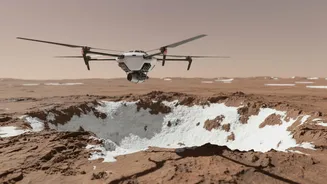
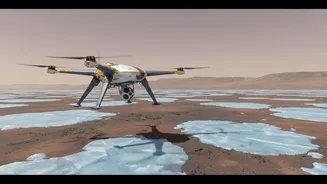
For decades, scientists have known that Mars holds vast quantities of water, but it's almost all frozen and often buried. This ice represents a vital resource for future astronauts. It's not just for drinking; it can be split into hydrogen and oxygen
to create breathable air and, crucially, rocket propellant. Being able to manufacture fuel on Mars, a practice known as in-situ resource utilization, could be the key to making a round trip to the planet plausible. The challenge, however, is that orbiters can only provide a rough idea of where this ice might be. They struggle to see the crucial first few meters below the dusty surface, leaving a critical gap in our knowledge. Mission planners need to know if the ice is buried under a meter of loose soil or ten meters of solid rock.
From Ingenuity to a Flying Workhorse
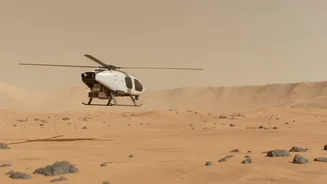
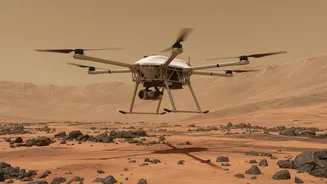
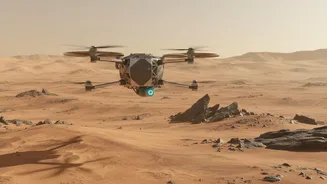
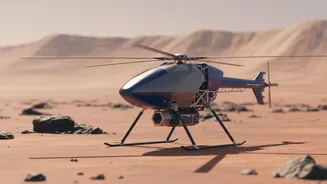
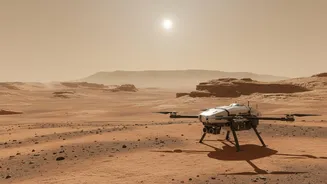
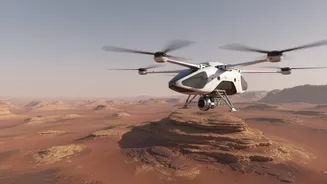
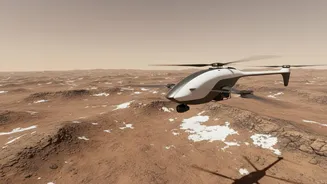
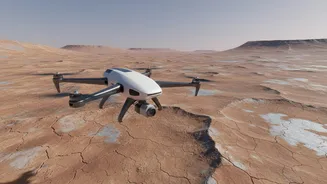
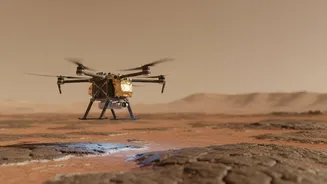
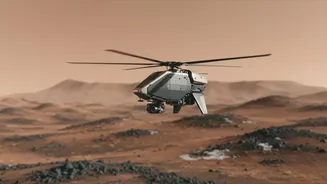
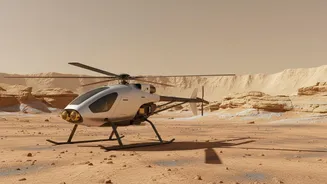
The trailblazing Ingenuity helicopter proved that powered, controlled flight was possible in Mars' thin atmosphere. It completed 72 flights, acting primarily as a technology demonstration and a scout for the Perseverance rover. The Skyfall concept, developed at NASA's Jet Propulsion Laboratory (JPL), represents the next logical step: turning the helicopter from a scout into a primary science investigator. Unlike the 1.8-kilogram Ingenuity, the proposed Skyfall mission would involve a trio of larger, more capable helicopters. These autonomous rotorcraft would not require a rover for support, and would be designed to carry a sophisticated suite of scientific instruments to map the terrain and its subsurface composition.
Aerial X-Ray Vision
The key innovation of the Skyfall concept is its ability to find ice from a low-altitude flight. Each helicopter would be equipped with a lightweight, ground-penetrating radar. In a clever piece of engineering, the antenna for this radar is designed as a flexible, fabric-like 'cape' that hangs below the helicopter. This allows it to get a clear view of the ground without breaking upon landing. By flying low and slow, Skyfall could capture high-resolution 3D maps of the subsurface, distinguishing the fine layers where dry dust gives way to ice. This aerial approach fills the critical observation gap between what orbiters can see from high above and what a rover can analyze on the ground.
A Mission Unlike Any Other
The proposed deployment for the Skyfall mission is as innovative as the helicopters themselves. The concept involves a daring mid-air maneuver where the entry vehicle would release the helicopters during its descent through the Martian atmosphere. The helicopters would then unfold, start their rotors, and fly themselves to separate, safe landing spots. Once on the ground, they would operate as a coordinated team, fanning out to survey large areas that would be inaccessible or too time-consuming for a rover to cover. In addition to the radar, the helicopters would carry high-resolution color cameras to build detailed terrain maps, along with sensors to study surface materials and weather patterns.