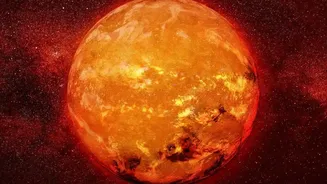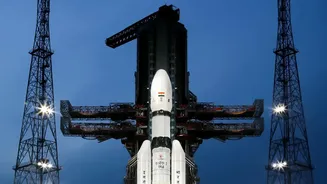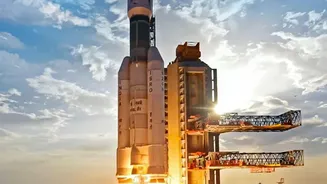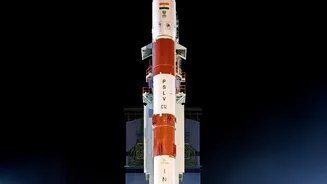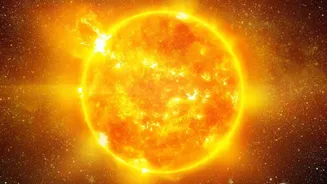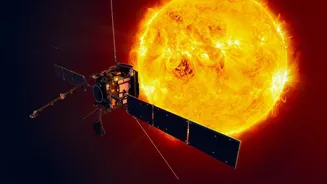



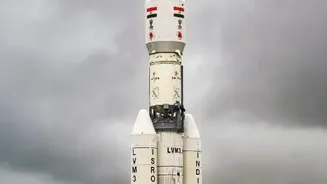
India's Aditya-L1 solar mission is already changing how we see the Sun. Scientists have used it to discover that a massive solar eruption did not expand uniformly, challenging old assumptions and paving the way for better space weather forecasts.
A Solar Storm with a Twist
For decades,
scientists have often modelled major solar eruptions, known as Coronal Mass Ejections (CMEs), as symmetrical bubbles of plasma expanding uniformly from the Sun. However, new findings from India's pioneering solar observatory, Aditya-L1, have provided a more complex and fascinating picture. Scientists from the Indian Institute of Astrophysics (IIA) in Bengaluru studied a CME that occurred on August 5, 2024. Their analysis revealed that the eruption was far from symmetrical. Instead, it was tilted and expanded unevenly, developing an asymmetric shape as it travelled away from the Sun. This discovery fundamentally challenges the conventional 'expanding bubble' model and offers a more nuanced understanding of these powerful solar events.
The Technology Behind the Finding
This breakthrough was made possible by the unique capabilities of Aditya-L1's primary instrument, the Visible Emission Line Coronagraph (VELC). While conventional coronagraphs are excellent at tracking the sideways movement of a CME across the sky, VELC does something more. It uses a technique called Doppler spectroscopy to measure how plasma is moving towards or away from the observer. By analysing shifts in the wavelength of light from the eruption—a blue shift for plasma moving closer and a red shift for plasma moving away—scientists detected complex internal motions. Combining this crucial data with images from NASA's Solar Dynamics Observatory and advanced 3D modelling, the IIA team was able to reconstruct the eruption's true, lopsided geometry. A model assuming uniform expansion simply couldn't replicate what VELC saw, but a model with a tilt and uneven expansion was a near-perfect match.
Why This Finding Matters
Understanding a CME's true shape is not just an academic exercise; it has profound implications for protecting our technology-dependent world. CMEs are the primary drivers of space weather, the stream of charged particles from the Sun that can disrupt and damage satellites, communication networks, GPS navigation, and even power grids on Earth. The shape and structure of a CME can influence its speed and how it interacts with the solar wind on its journey through space. An unevenly expanding eruption might experience different levels of drag, altering its trajectory and, crucially, its arrival time at Earth. More accurate models that account for this asymmetry can lead to better predictions, giving satellite operators and power grid managers more precise warnings to take protective measures.
A Major Milestone for Indian Science
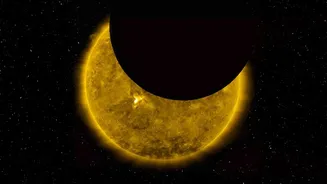
This discovery is a significant achievement for the Indian Space Research Organisation (ISRO) and the scientists at IIA who designed and built the VELC instrument. It demonstrates the advanced capabilities of Aditya-L1, India’s first dedicated solar observatory, which is positioned 1.5 million kilometres from Earth at the Sun–Earth L1 point. From this vantage point, it can observe the Sun continuously without interruption. By providing data that ground–based telescopes and other spacecraft could not, Aditya–L1 is cementing India's role as a key player in global space science. The mission is not just collecting data but providing unique insights that push the boundaries of solar physics and help safeguard our future in an increasingly space–reliant world. This initial finding is a promising sign of the many discoveries yet to come from India's eye on the Sun.