



More Than Just a Landslide
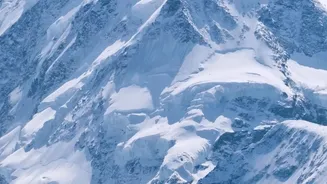
First, it's important to understand that these events are not typical snow avalanches or simple rockfalls. They are often a potent mixture of immense quantities of rock and glacial ice. This combination is key to their extraordinary mobility. Events like
the 2021 Chamoli disaster in Uttarakhand, where a mass of rock and ice collapsed from Ronti Peak, demonstrated this terrifying potential. The initial collapse might involve millions of cubic metres of material, beginning as a rockslide but quickly evolving as it hurtles downslope. This transformation into a fast-moving, long-runout flow is what makes them a unique and complex hazard in mountainous regions.
The Paradox of Friction
In theory, friction should stop a landslide relatively quickly. The immense weight of rock grinding against the ground and against itself should generate enormous resistance, slowing the mass to a halt. For decades, scientists were puzzled by why large rock avalanches, especially those mixed with ice, behave as if friction barely exists. They travel distances that defy the simple physics of a sliding block. This observation led to the understanding that powerful mechanisms must be at play to reduce this internal and basal friction, effectively lubricating the flow from within and allowing it to maintain momentum over vast distances.
The Power of Frictional Heating and Fluidization
One of the primary explanations is a process that sounds complex but is powerfully simple: frictional heating. As the massive slab of rock and ice accelerates down a steep mountain face—sometimes falling over a kilometre—the internal grinding and shearing generate intense heat. This heat is enough to instantly melt the ice mixed within the avalanche. This meltwater, along with any water entrained from the path, creates a highly pressurized slurry at the base of the flow. This slurry can lift the overlying rock and debris, allowing it to ride on a cushion of water, dramatically reducing friction and enabling it to flow like a fluid—a process known as fluidization. The result is a hyper-mobile debris flow that can reach incredible speeds.
Dynamic Fragmentation: Shattering on the Move
Another crucial process is 'dynamic fragmentation'. As the avalanche descends, the immense forces cause the rocks within it to shatter and break apart. This is not a passive process; the fragmentation itself releases energy and fundamentally changes the nature of the moving mass. The creation of smaller particles increases the material's ability to flow, contributing to the fluidization effect. Think of it as the avalanche generating its own lubricant and ball bearings as it moves. This continuous shattering process helps maintain the flow's energy and mobility, pushing it further downstream than would otherwise be possible. It helps explain why the deposits of these long-runout avalanches are often composed of intensely fragmented debris.
The Himalayan Context
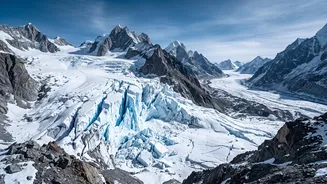
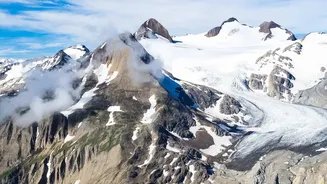
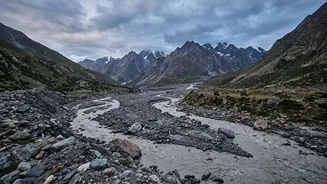
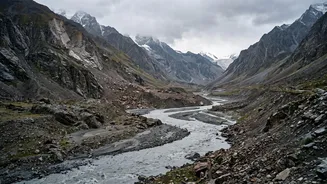
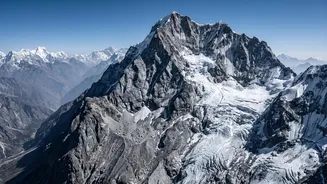
The Himalayas are uniquely susceptible to these phenomena. The region's steep topography, active geology, and the presence of numerous glaciers provide the perfect ingredients. Climate change is also a contributing factor, as warming temperatures can degrade permafrost—the frozen 'glue' holding rock faces together—and destabilize hanging glaciers. When a rock mass on or near a glacier fails, it sets off a potential chain reaction. The resulting rock-ice avalanche can then enter river systems, transforming into a devastating debris flow or flash flood that travels far from the initial collapse site, as tragically witnessed in both the Chamoli and recent Nepal disasters.