
Our Galactic Neighbor
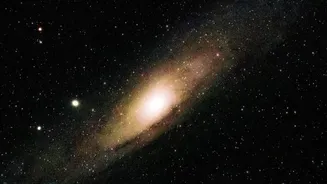
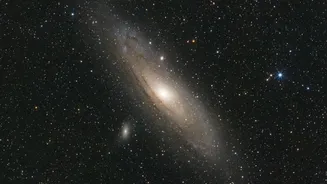
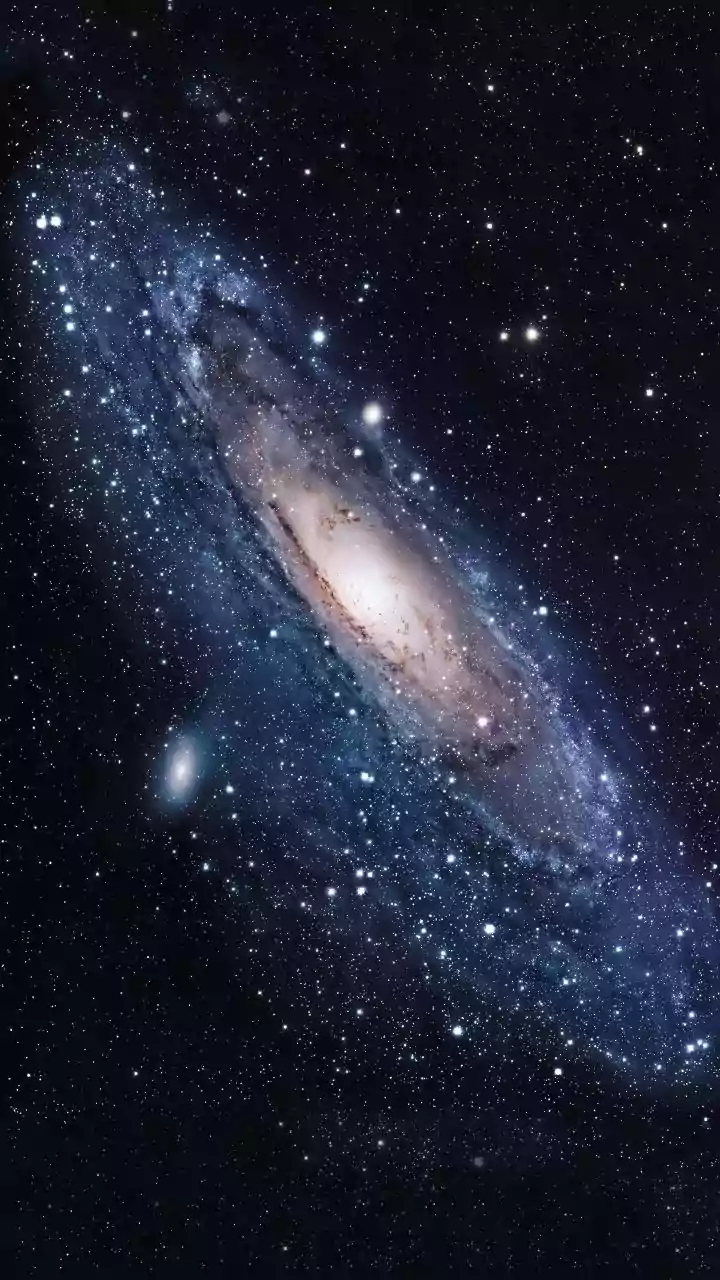
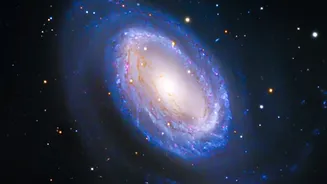
The Andromeda galaxy, also known as M31, is the closest major spiral galaxy to our own Milky Way. Located about 2.5 million light-years away, it's so close that it's visible to the naked eye under dark skies as a faint, fuzzy patch of light. This proximity
makes it a perfect natural laboratory for astronomers. While we can't get a bird's-eye view of the Milky Way from within it, studying Andromeda is like looking at a sibling to understand our own family. It allows scientists to see a grand spiral structure in its entirety, helping them piece together the story of how large galaxies like ours form, live, and evolve.
Reading the Fossil Record
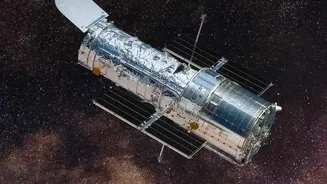
To understand a galaxy's history, astronomers act like cosmic archaeologists, studying its stars. Massive, young stars burn hot and blue but have short lives, while smaller, less massive stars are redder and live much longer. By mapping the colours of stars across a galaxy, scientists can identify which regions have been active with recent star birth and which have older, more settled populations. This stellar population is often called the "fossil record" of a galaxy's life. The Hubble Space Telescope is uniquely capable of this work, with the power to resolve millions of individual stars within Andromeda, providing an unprecedentedly detailed historical account.
Hubble's Unprecedented Survey
A recent, comprehensive study leveraged data from two major Hubble surveys that, combined, mapped about two-thirds of Andromeda's sprawling disk. This ambitious project, part of the PHANGS (Physics at High Angular Resolution in Nearby GalaxieS) program, involved measuring the properties of around 200 million individual stars. By dividing the galaxy into thousands of smaller regions and analysing the age and type of stars within each, researchers were able to build a detailed, historical map of star-forming activity across the galaxy over hundreds of millions of years.
The 'Quiet Phase' Explained
The study revealed a clear trend: star formation in Andromeda has been steadily declining for the past 500 million years, with the slowdown becoming even more pronounced in the last 40 million years. Following a major burst of star birth about 2 billion years ago, likely triggered by a galactic merger, Andromeda has been winding down. Today, its star formation rate has plummeted to about one-fifth of a solar mass per year. This doesn't mean the galaxy is dead, but rather that it's transitioning from a turbulent, active youth to a more quiescent middle age, like a bustling city that has completed its major construction boom and is now settling into a slower pace of growth.
Winding Down From the Outside In
Interestingly, this slowdown isn't uniform across the entire galaxy. Much of the decline is linked to a prominent ring of gas and dust located about 32,000 light-years from the galactic centre. This ring was once a hyperactive hub of star formation, but its activity has faded, which has significantly impacted the galaxy's overall production rate. Researchers believe this is a natural stage in the life cycle of a large spiral galaxy, not a sign that it has run out of the raw gas needed to make stars. As one astronomer put it, it's like taking a breather after running a marathon.
A Glimpse into the Milky Way's Future
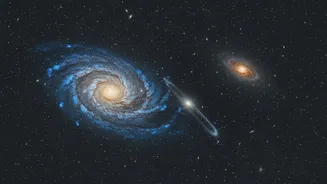
By studying Andromeda's gentle decline, we are getting a potential preview of our own galaxy's distant future. The Milky Way is expected to follow a similar evolutionary path, eventually settling into its own quieter phase. This cosmic story has a dramatic final act: in about 4.5 billion years, the Milky Way and Andromeda are predicted to collide and merge, forming a new, giant galaxy. Observing Andromeda's current state provides invaluable clues for understanding the long-term evolution of galaxies and our own ultimate cosmic destiny.